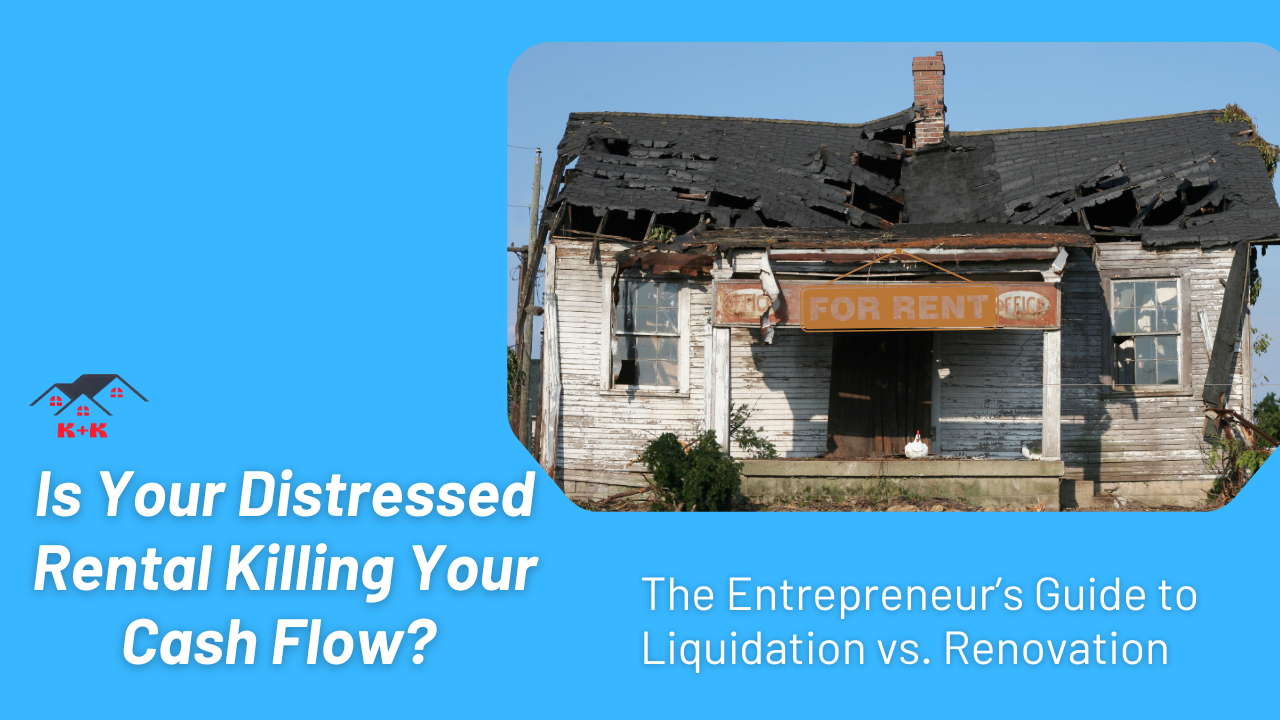
Rental properties are often pitched as “passive income,” but for many entrepreneurs, a distressed rental becomes anything but passive. When repair costs, compliance risks, and time demands start draining more resources than the property generates, the smartest move may not be renovation—but liquidation. This guide helps business owners evaluate when holding a rental stops making financial sense and how strategic selling can unlock capital for higher-return opportunities.
Key Takeaways
- A distressed rental can quietly drain cash flow, time, and focus from your business
- Renovation costs extend far beyond materials and labor
- Return on equity—not emotional attachment—should drive decisions
- Selling as-is can unlock capital for higher-return business investments
- Strategic liquidation can reduce stress and improve overall financial clarity
For small business owners and entrepreneurs, every asset must earn its place. A rental property that once produced steady income can quietly turn into a cash-flow drain when major repairs, tenant issues, or regulatory pressures enter the picture. Instead of supporting business growth, the property starts consuming time, capital, and mental bandwidth.
In markets like Indianapolis, where housing compliance laws have tightened and renovation costs continue to rise, many owners are re-examining a critical question: Is it smarter to renovate a distressed rental—or exit it entirely? This article breaks down that decision from a business perspective, not an emotional one, and explains when selling a property as-is—often through buyers like KK Buys Indy Homes—can be the more strategic move.
Table of Contents
The Hidden Costs of “Fix and Hold” Rentals
As an entrepreneur, your most valuable resource is your time. Every hour you spend managing a renovation is an hour you aren’t spending on your primary business. In the current Indianapolis market, renovation costs have risen significantly due to labor shortages. If you choose to fix a distressed property, you aren’t just paying for the repairs; you are also paying for:
- Holding costs: Property taxes (subject to Indiana’s rental caps), insurance, utilities, and vacancy periods
- Time diversion: Contractor coordination, inspections, permits, and follow-ups
- Legal exposure: New Indiana habitability laws require issues like mold or plumbing failures to be addressed within as little as 72 hours
- Opportunity cost: Time spent managing renovations is time not spent growing your primary business
For many entrepreneurs, the rental stops functioning as an asset and becomes a second job—often with single-digit returns.
Table: Renovation vs. Liquidation — A Business Comparison
| Factor | Renovate & Hold | Sell As-Is |
|---|---|---|
| Upfront cash required | High (repairs, labor, permits) | None |
| Time investment | Months of oversight | Minimal |
| Legal compliance risk | Ongoing | Transferred |
| Cash flow timeline | Delayed | Immediate |
| Flexibility for business reinvestment | Limited | High |
| Stress level | High | Low |

Calculating the Tipping Point: Return on Equity
Entrepreneurs should evaluate distressed rentals using return on equity, not sunk costs. If a property worth $200,000 requires $30,000–$50,000 in remediation just to remain compliant, that equity is effectively frozen.
Selling the property—often through an as-is buyer like KK Buys Indy Homes—converts illiquid equity into deployable capital. For business owners, that cash can be redirected toward inventory, marketing, hiring, or expansion efforts that often generate far higher returns than a struggling rental.
Case Study: Reclaiming Time and Capital
A Broad Ripple business owner recently faced this exact scenario: an inherited rental with moisture damage and aging plumbing. The owner spent nearly 10 hours per week managing contractors and tenant complaints—time pulled directly from an e-commerce business.
By selling the property as-is instead of investing $45,000 in renovations, the owner redeployed capital into inventory with a 25% margin—far exceeding the rental’s 6% return. The exit wasn’t a loss; it was a strategic reallocation of resources.
When Selling Becomes the Smarter Business Decision
Liquidating a distressed rental isn’t failure—it’s financial discipline. For entrepreneurs, clarity matters more than attachment. Selling as-is removes liabilities from your balance sheet and allows you to refocus on assets that align with your growth goals.
If your rental property has turned into a “second job” that causes more stress than profit, it may be time to sell my house fast Indianapolis. Companies like KK Buys Indy Homes specialize in helping owners exit distressed properties without repairs, clean-outs, or long closing timelines—making liquidation a viable option rather than a last resort.

FAQs
How do I know if my rental property is hurting my cash flow?
If repair costs, vacancy time, and management demands consistently exceed net rental income, your property may be operating at a negative return on equity. Entrepreneurs should also factor in opportunity cost—what that time and capital could earn elsewhere.
Is it better to sell a distressed rental or renovate it?
That depends on return potential. If renovation costs are high and post-repair rental returns remain modest, selling often makes more business sense. Liquidation converts trapped equity into flexible capital.
Can I sell a rental property with mold or major structural issues?
Yes. Buyers like KK Buys Indy Homes specialize in purchasing distressed properties as-is, including those with mold, plumbing failures, or structural damage—without requiring repairs.
How fast can I sell a distressed rental for cash?
Cash buyers using private capital can often close in as little as 7 days, allowing owners to stop holding costs immediately.
Do I need to pay commissions or closing costs when selling as-is?
Typically no. Direct buyers often cover closing costs and charge no agent commissions, simplifying the exit process.