

Key Takeaways
- Start lean, validate fast. Don’t invest heavily until you’ve tested your idea.
- Structure matters. An LLC or corporation protects your personal assets.
- Legal compliance is not optional. Even home-based businesses need licenses.
- Marketing fuels growth. Customers won’t find you unless you put yourself out there.
- Financial discipline keeps you alive. Separate personal and business finances from day one.
- Continuous learning pays off. The most successful home businesses adapt and evolve.

Starting a small business from home is one of the most rewarding ways to take control of your career, income, and future. For many entrepreneurs, a home-based business is not just a stepping stone—it’s the business itself. With today’s technology, you can run everything from a one-person consulting firm to a full-fledged online store without ever renting office space.
But as exciting as it sounds, starting a business from home requires more than just a good idea. You need a plan, legal awareness, financial discipline, and the right mindset to turn a home office into a profit center.
This guide walks you step-by-step through the process of how to start a small business from home, weaving together strategy, practical tips, and real-world lessons. Think of it as your roadmap to building a small business from your living room, kitchen table, or garage—and making it thrive.
Table of Contents

Step 1: Assess Yourself and Your Idea
Every business begins with an idea, but the truth is, not all ideas are good business ideas. The ones that succeed tend to sit at the intersection of three things: your skills, your passion, and the market demand. Before you invest money, time, or energy, it’s worth taking an honest inventory of yourself and your concept.
Skills: What are you really good at?
Think of skills as your “competitive edge.” These can come from work experience, hobbies, or even life lessons. For example, if you’ve been an accountant for years, you may be able to start a bookkeeping service from home. If you’ve been baking sourdough as a hobby, you could turn it into a small cottage bakery.
Ask yourself:
- Do I have a skill people will pay for?
- Can I deliver that skill reliably and at a professional level?
- If not, am I willing to learn quickly or outsource parts of it?
📌 Example: You might be great at designing logos, but if your weakness is sales, you’ll need to develop client acquisition strategies—or partner with someone who can.
Passion vs. Profit: Where’s the balance?
Passion is what fuels long nights and early mornings. Profit is what keeps the lights on. A successful business usually requires both.
- If you’re only passionate but there’s no market, you’ve got a hobby.
- If you’re only chasing profit in an area you don’t care about, you’ll burn out fast.
The sweet spot? Something you enjoy enough to stick with, and that others value enough to pay for.
📌 Example: You may love photography, but if your area is saturated with photographers, you’ll need to niche down—say, specializing in real estate photography for local agents.
Lifestyle Fit: Does this business work for your reality?
Running a business from home doesn’t happen in a vacuum. Your family, schedule, and environment all play roles in your success.
Ask yourself:
- Do I have a quiet workspace at home?
- Will this business demand odd hours that conflict with family life?
- Can I manage the stress and uncertainty that comes with entrepreneurship?
📌 Example: If you’re raising small children and need flexible hours, an online consulting business may be a better fit than running a home-based catering business that requires nights and weekends.
Validation: Test Before You Leap
Even if your idea checks the boxes for skills, passion, and lifestyle, don’t assume it will work in the real world. The fastest way to test an idea is to get it in front of people.
- Talk to potential customers.
- Run quick polls in online groups.
- Create a simple landing page to gauge interest.
- Sell a “minimum viable product” (MVP) before you scale.
📌 Example: Before starting a tutoring business, offer free or low-cost sessions to neighbors and ask for feedback. If parents immediately ask when your next session is, you’ve found demand.
Pro Tip: The earlier you validate, the cheaper your mistakes will be. Too many entrepreneurs sink thousands of dollars into websites, equipment, or branding—only to discover nobody wants what they’re selling. Start small, test fast, and pivot if needed.
Read the following articles:
- Work From Home: Tips for Turning Your Passion Into Profit
- How to Assess Your Business Idea
- When to Decide Not to Start a Business
- Turning Something You Love into a Profitable At-Home Business

Step 2: Research Your Market
Market research is one of the most overlooked steps when starting a small business from home. Many entrepreneurs fall in love with their idea and skip straight to branding, websites, or even buying equipment—only to discover later that there isn’t enough demand. The truth is, even the best idea won’t succeed if it doesn’t solve a problem people care about.
Doing market research doesn’t require hiring an expensive firm. With today’s tools, you can gather insights quickly and affordably—even for a small home-based business. The goal isn’t perfection; it’s to get a clear picture of your customers, competitors, and opportunities.
1. Identify Your Ideal Customer
Start by defining who you’re selling to. Instead of saying “everyone,” narrow it down to the specific group that’s most likely to buy. This is your target market.
Ask yourself:
- Who will benefit most from my product or service?
- What are their biggest pain points or desires?
- Where do they spend time online and offline?
Mini Case Study:
Retailer Lefty’s in San Francisco discovered a true niche: serving left-handed individuals—a group representing only around 10% of the population. By focusing PPC ads and their entire product line on left-handed tools and stationery, they created a profitable, highly targeted business.
📌 Example: If you’re offering bookkeeping for small businesses, your ideal customer might be solopreneurs and small firms making under $500,000/year—too small to hire a full-time accountant but big enough to need professional help.
💡 Pro Tip: Build a simple customer persona—a one-page summary of your target customer that includes their demographics (age, income, location) and psychographics (values, interests, motivations).
2. Analyze Your Competition
Competitors are not just obstacles—they’re teachers. They reveal what’s working in the market and where gaps exist.
Steps to analyze:
- Search Google for your business idea + location (e.g., “virtual assistant services in Dallas”).
- Browse competitor websites, pricing pages, and customer reviews.
- Study their strengths: Are they dominating social media? Do they offer fast delivery?
- Look for weaknesses: Do customers complain about poor service, limited options, or high prices?
📌 Example: If you notice most local caterers don’t offer gluten-free menus, that’s a potential niche for your home-based catering business.
💡 Pro Tip: Don’t just compete on price. Compete on value—better service, more personalization, or specialized expertise.
3. Spot Gaps and Opportunities
After studying customers and competitors, look for unmet needs. These are the opportunities where you can stand out.
Ask:
- Is there a niche being ignored?
- Can I offer better convenience, speed, or quality?
- Can I combine two services/products that competitors don’t?
📌 Example: Many people sell handmade jewelry online, but very few focus on “eco-friendly jewelry made from recycled materials.” That’s a clear differentiator.
4. Use Affordable Research Tools
You don’t need corporate-level budgets to do effective market research. Some free or low-cost tools include:
- Google Trends: See if interest in your product/service is rising or falling.
- Social Media Groups: Facebook groups, Reddit communities, and LinkedIn forums reveal real conversations.
- Survey Tools: Create a simple Google Form or Typeform to gather insights from potential customers.
- Keyword Tools: Free versions of SEMrush, Ahrefs, or Ubersuggest show what people are searching for.
- Amazon Reviews: Read reviews of similar products—customers often reveal what they love and what’s missing.
Mini Case Study:
In niche marketing, hyper-specialized campaigns often yield outsized results. A small ethnic-focused food portal that zeroed in on one specific immigrant community deliberately outperformed broader content sites. Highly targeted content can outperform generic broad-market strategies.
💡 Pro Tip: If you don’t have an audience yet, ask friends, family, or peers to share your survey with people in your target market. Keep it short—5–7 questions max.
5. Test Your Assumptions Early
The best research is action. Instead of only analyzing, run a small test.
Ways to test:
- Create a simple landing page with your offer and collect emails.
- Run a low-budget Facebook or Google ad to see if people click.
- Offer your product or service at a discounted rate to your first 5–10 customers in exchange for feedback.
- Sell a “minimum viable product” (MVP) version before investing fully.
Mini Case Study:
Pretotyping (sometimes called “fake-door testing”) is credited to Google for its effectiveness. It lets you gauge interest before developing a product—save time and money by confirming whether the target audience shows genuine curiosity.
📌 Example: If you want to sell homemade candles, start by offering 20 units to neighbors or on Etsy. If they sell quickly and you get repeat orders, you know demand exists.
Read the following articles:
- Finding the Right Work at Home Opportunities
- Use Social Trends to Find Market Opportunities in Business
- 5 Things Every New Business Owner Should Know
- Tips and Techniques for Researching the Competition

Step 3: Write a Business Plan
A business plan is your roadmap. It doesn’t have to be 50 pages long or packed with jargon, but it should force you to think through the what, who, and how of your business. Without it, you’re flying blind—and small missteps can quickly turn into big setbacks.
Think of it as a GPS: it won’t guarantee you won’t hit traffic, but it keeps you moving in the right direction and gives you options if you need to reroute.
Why You Need a Business Plan (Even for a Home Business)
Many home-based entrepreneurs skip this step because they assume it’s only for big startups seeking investors. But a business plan benefits you just as much as potential lenders. It helps you:
- Clarify your idea and make it concrete.
- Spot risks and weak points before you spend money.
- Create realistic financial projections.
- Stay accountable as you grow.
📌 Example: A freelance graphic designer who builds a one-page plan with income goals, target clients, and pricing strategy will have a far smoother path than one who just “wings it” and hopes clients appear.
What to Include in a Business Plan
Your plan doesn’t need to be complicated. At minimum, cover these areas:
- Executive Summary: A snapshot of your business idea, mission, and goals.
- Business Description: What exactly are you offering and why does it matter?
- Market Analysis: Who are your customers, and how big is the opportunity?
- Competitive Analysis: Who else is doing this, and how will you stand out?
- Marketing Plan: How will you attract and retain customers?
- Operations Plan: How will the business run day-to-day? (tools, processes, delivery).
- Financial Plan: Startup costs, revenue model, pricing, and break-even point.
💡 Pro Tip: Don’t overcomplicate it. A home-based baking business doesn’t need a 50-page document. A 2–3 page lean plan is enough to clarify direction.
Lean Business Planning Approach
If the idea of writing a formal plan makes you freeze, start with a lean business plan. This is a short, flexible document that can be updated often.
Key elements:
- Problem: What issue are you solving?
- Solution: Your product or service.
- Key Metrics: How you’ll measure success (sales, leads, profit margin).
- Unique Value Proposition (UVP): Why customers should choose you over competitors.
- Channels: How you’ll reach customers (social media, referrals, website).
- Revenue Streams: How you’ll make money.
- Cost Structure: Your main expenses.
👉 This is a living document. Update it as you grow and learn.
Mini Case Study: How a Simple Plan Saved a Startup
When Spanx founder Sara Blakely started her billion-dollar shapewear empire, she didn’t begin with a 50-page investor plan. Instead, she wrote down her problem (uncomfortable undergarments), her solution (footless pantyhose), and her target market (women needing seamless undergarments). By keeping it simple but focused, she was able to pitch confidently and stay consistent.
Even if your home-based business never seeks outside investors, having a clear, written plan can save you from costly mistakes and help you scale with confidence.
💡 Pro Tip: Think of your business plan as a “working document,” not a one-time project. As your business evolves, update it regularly. That way, it grows with you rather than collecting dust in a folder.
Read the following articles:
- Basics of a Business Plan
- Why You Really Do Need a Business Plan Before You Launch Your Startup Dream
- 10 Apps and Tools for Entrepreneurs to Write a Winning Business Plan
- Business Plan: Your Road Map to Success

Step 4: Choose the Right Business Structure
Your business structure determines how you pay taxes, how much personal liability you have, and how much paperwork you’ll face. For a home-based business, this decision is crucial—it can protect your personal assets, shape your credibility, and influence your future growth.
The good news: you don’t need to be a lawyer to make a smart choice. But you do need to understand the basics.
Most Common Business Structures for Home Businesses
1. Sole Proprietorship
- What it is: The simplest and most common structure. You and your business are the same legal entity.
- Pros: Easy and cheap to set up, minimal paperwork, straightforward taxes.
- Cons: No liability protection—if your business is sued, your personal assets (house, savings) are at risk.
- Best for: Freelancers, consultants, or side hustlers starting small with low risk.
📌 Example: A freelance writer who invoices clients under their own name is typically a sole proprietor.
2. Limited Liability Company (LLC)
- What it is: A hybrid structure that protects your personal assets while allowing pass-through taxation.
- Pros: Liability protection, flexible management, not as complex as a corporation.
- Cons: Filing fees (varies by state, often $50–$500), annual reports, and compliance requirements.
- Best for: Entrepreneurs who want to protect personal assets and look more professional.
📌 Example: A home-based catering business might form an LLC to shield the owner’s home and savings from liability if a customer has a food safety issue.
3. S Corporation (S Corp)
- What it is: A tax status you can elect for your LLC or corporation. Profits/losses pass through to your personal tax return.
- Pros: Potential tax savings (less self-employment tax), liability protection.
- Cons: More IRS scrutiny, stricter rules for paying yourself a salary vs. dividends.
- Best for: Profitable home businesses earning enough revenue to justify tax savings.
📌 Example: A consultant earning $150,000 per year may switch from an LLC to an S Corp to reduce self-employment tax.
4. Corporation (C Corp)
- What it is: A separate legal entity with shareholders.
- Pros: Strongest liability protection, easier to raise capital, unlimited growth potential.
- Cons: Double taxation (profits taxed at the corporate level, then dividends taxed again), complex paperwork.
- Best for: Ambitious startups planning to scale big or seek outside investors.
📌 Example: While rare for home-based businesses, a tech founder developing an app from home might form a C Corp if they plan to pitch to venture capitalists.
How to Decide What’s Right for You
Ask yourself:
- Do I need liability protection?
- Do I plan to keep this as a small side business or grow into something larger?
- Am I comfortable with extra paperwork and costs for added protection?
Mini Case Study: The Freelance Designer Who Became an LLC
Emily started as a freelance graphic designer under a sole proprietorship. Things went well until a client threatened legal action over a contract dispute. Although the issue was resolved, Emily realized her personal savings were at risk. She converted to an LLC, spending $200 in filing fees in her state. Not only did this protect her personal assets, but it also gave her more credibility with larger corporate clients.
Business Structure Comparison Table
| Structure | What It Is | Pros | Cons | Best For | Cost & Complexity |
|---|---|---|---|---|---|
| Sole Proprietorship | You and your business are the same legal entity. | – Easiest to start – Low cost – Simple taxes | – No liability protection – Harder to raise capital | Freelancers, consultants, side hustles with low risk | Filing often free or <$50, minimal paperwork |
| LLC (Limited Liability Company) | Separate legal entity that protects personal assets, with flexible tax options. | – Liability protection – Flexible management – More credibility | – State filing fees – Annual reports required in many states | Small to mid-sized home businesses wanting protection and professionalism | $50–$500 filing fee, ongoing compliance |
| S Corporation (S Corp) | A tax status elected by an LLC or corporation for pass-through taxation. | – Liability protection – Tax savings on self-employment tax – Still flexible | – More IRS scrutiny – Must pay “reasonable salary” to owners | Profitable home businesses earning enough to benefit from tax savings | Moderate complexity, requires payroll setup & filings |
| C Corporation (C Corp) | Separate legal entity with shareholders, unlimited growth potential. | – Strongest liability protection – Attractive to investors – Easier to raise capital | – Double taxation – Complex paperwork – Higher costs | Ambitious startups planning to scale or seek VC funding | $300–$1,000+ filing fees, heavy compliance burden |
Quick Takeaway:
- If you’re just testing an idea, start as a Sole Proprietor.
- If you want liability protection and professionalism, go with an LLC.
- If you’re earning high revenue and want tax efficiency, consider an S Corp.
- If you’re seeking investors and aiming big, a C Corp might make sense.
💡 Pro Tip: Many home-based businesses follow a natural progression: Sole Proprietorship → LLC → S Corp (for tax benefits as profits grow).
Many entrepreneurs start a small business as sole proprietors for simplicity and later convert to an LLC once revenue grows or risks increase. Think of your structure as evolving with your business, not a one-time decision you’re stuck with forever.

Step 5: Understand Legal & Licensing Requirements
When you start a small business from home, it doesn’t mean that you can skip the rules. Even small or part-time home businesses are subject to local, state, and sometimes federal requirements. Skipping this step can lead to fines, shutdowns, or even lawsuits.
Think of licensing and permits not as red tape, but as a way to protect your business, build credibility, and avoid costly mistakes.
1. Business Licenses
Most cities and counties require some form of a general business license for any enterprise operating within their jurisdiction, even if it’s home-based.
- Typically obtained from your city hall or county clerk’s office.
- Costs can range from $25 to a few hundred dollars annually.
- Some jurisdictions require renewal each year.
📌 Example: A home-based virtual assistant in Los Angeles still needs a city business license to operate legally.
2. Home Occupation Permits
Many municipalities require a home occupation permit to ensure your business won’t disrupt the neighborhood.
Typical rules include:
- Limited signage outside your home.
- Restrictions on customer visits (traffic and parking issues).
- Noise or environmental restrictions (no heavy machinery).
📌 Example: If you’re baking cupcakes from home, your town might allow it only if customers don’t come to your house to pick up orders. Deliveries or shipping may be required instead.
3. Zoning Laws
Zoning regulations dictate what kinds of businesses can operate in residential areas.
- Some areas restrict retail operations in residential zones.
- You may be prohibited from storing large quantities of inventory in your garage.
- Certain businesses (like auto repair shops) may be outright banned in neighborhoods.
💡 Pro Tip: Check your city’s zoning laws before spending money on equipment.
4. Health & Safety Permits
If your business deals with food, beauty, or health products, you may need inspections and permits.
- Food businesses: Must comply with local health department standards.
- Cosmetics/skincare: May need FDA compliance in addition to local licenses.
- Childcare services: Require strict safety inspections and certifications.
📌 Example: A woman in Texas launched a cottage bakery from her kitchen. She had to complete a food safety course and pass inspections from the health department before selling to the public.
5. Professional Licenses
Some industries require professional certification or licensing to legally provide services. Examples include:
- Accountants, financial advisors, and lawyers.
- Real estate agents.
- Cosmetologists and barbers.
- Therapists and counselors.
Even if you’re working from home, these rules still apply.
6. Federal & State Tax Registration
- Employer Identification Number (EIN): Required if you hire employees, operate as an LLC/corporation, or want to open a business bank account. You can apply for free at IRS.gov.
- Sales Tax Permit: Required in most states if you sell taxable goods or services.
- State Business Registration: Check your state’s secretary of state website.
Mini Case Study: The Etsy Seller Who Got Fined
A jewelry maker in Florida opened an Etsy shop from her home. She assumed that selling online meant she didn’t need a license. A year later, the county sent her a notice for unpaid local business taxes and fines. She had to pay over $500 to catch up. The lesson? Even online-only businesses often require local registration.
7. Insurance Requirements
While technically not a license, many states and cities require proof of insurance to get permits. For example, home-based daycare providers typically need liability coverage before approval.
💡 Pro Tip: Start with your city hall or county clerk’s office. Ask: “What do I need to legally run a business from my home?” They’ll guide you through the local requirements, and from there you can confirm state and federal obligations.

Step 6: Calculate Your Startup Costs
One of the biggest reasons home-based businesses fail isn’t lack of passion—it’s running out of money. Many entrepreneurs underestimate how much it will take to get off the ground, then hit roadblocks when unexpected bills arrive. Calculating your startup costs early helps you:
- Avoid financial surprises.
- Determine how much funding you actually need.
- Set realistic pricing to cover expenses.
- Forecast when you’ll break even and start making a profit.
The good news? Compared to traditional businesses, home-based startups are far more affordable. But “affordable” doesn’t mean “free.”
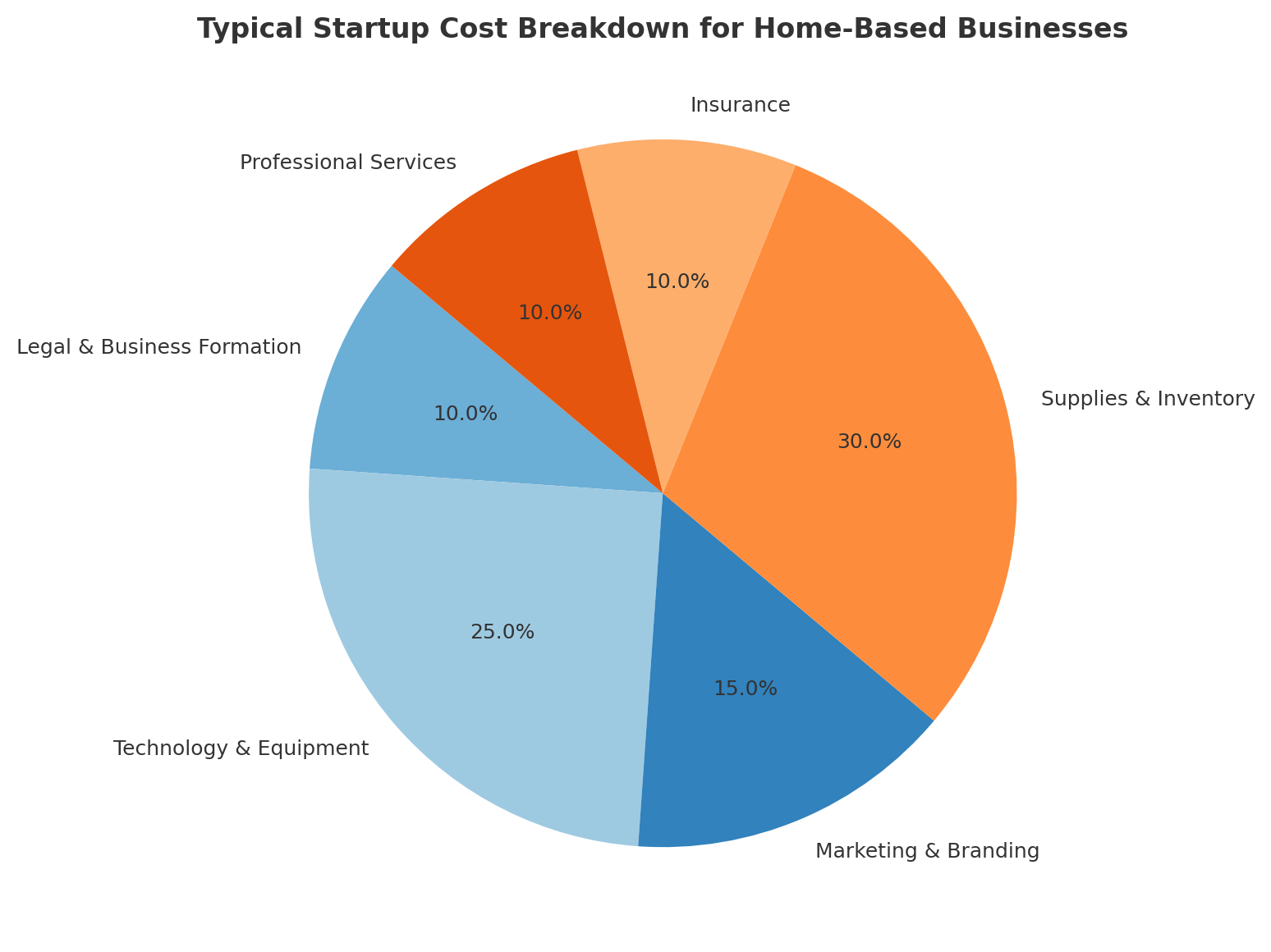
1. Typical Startup Costs for Home-Based Businesses
Even small ventures often require investments in these categories:
- Business Formation & Legal Fees
Filing an LLC, permits, licenses.
Range: $50 – $1,000 depending on state and industry. - Technology & Equipment
Laptop, printer, software, website domain/hosting.
Range: $500 – $3,000. - Marketing & Branding
Logo design, website, business cards, social media ads.
Range: $100 – $2,500. - Supplies & Inventory
Materials for handmade products, packaging, or resale goods.
Range: $200 – $5,000. - Insurance
Home-business insurance, liability coverage.
Range: $300 – $1,200 per year. - Professional Services
Accounting, legal consultation, bookkeeping software.
Range: $200 – $2,000 annually.
📌 Example: A freelance writer starting from home may spend only $1,000 upfront (laptop, software, website). A home bakery, on the other hand, may require $5,000–$10,000 (equipment, supplies, inspections, permits).
2. One-Time vs. Ongoing Costs
Break expenses into two categories:
- One-Time Costs: Registration fees, equipment purchases, and furniture.
- Ongoing Costs: Internet, software subscriptions, marketing ads, insurance, and inventory restocking.
💡 Pro Tip: Many entrepreneurs forget recurring costs like email software or monthly website hosting. These small fees add up quickly and eat into your cash flow.
3. Estimate Conservatively
Always assume costs will be higher and revenue slower than expected. If you think it will take 3 months and $3,000 to launch, prepare for 6 months and $5,000. Conservative planning reduces stress and improves survival odds.
4. Build a “Bare Minimum” Budget
Separate what you must have from what’s just “nice-to-have.”
- Bare Minimum: A website, laptop, internet connection, legal compliance.
- Nice-to-Have: Professional logo, upgraded equipment, fancy software.
📌 Example: If you’re starting an Etsy shop, you need product materials and listings right away. Paid SEO tools or a custom-built website can come later.
5. Break-Even Analysis
Once you know your costs, calculate your break-even point—the sales needed to cover expenses.
Formula:
Break-Even Sales = Fixed Costs ÷ Gross Profit Margin
📌 Example:
If your fixed costs are $1,000/month and your gross profit margin is 50%, you’ll need $2,000 in sales per month just to break even.
Mini Case Study: The Consultant Who Underestimated Costs
Marcus launched an online consulting business, assuming his only expense would be Zoom. But he quickly realized he needed project management software, an email marketing platform, liability insurance, and professional accounting help. His actual monthly costs were $450—triple what he estimated. By revising his pricing and charging more realistic rates, he was able to cover expenses and hit profitability in six months.
6. Tools to Help You Estimate Costs
- SBA Startup Cost Worksheet: Free calculator from the Small Business Administration.
- Spreadsheet Templates: Use Excel or Google Sheets to track one-time vs. recurring costs.
- Accounting Software: QuickBooks, Wave, or FreshBooks can help forecast and track expenses.
💡 Pro Tip: Always pad your budget by at least 20%. Unexpected costs—from website bugs to permit fees—will arise, and having a cushion prevents you from stalling out.

Step 7: Figure Out How to Fund Your Business
Even home-based businesses need money to get started. While your costs may be far lower than a traditional storefront, you’ll still face expenses for licenses, equipment, technology, and marketing. The key is choosing the right way to fund your business without overextending yourself.
The golden rule: start lean, borrow smart, and grow with revenue whenever possible.
Here are the pros and cons of some of the ways to finance your small business:
1. Bootstrapping (Self-Funding)
This is the most common way home businesses begin—funding your business from your own savings, income, or side hustle.
- Pros: No debt, no interest, total control.
- Cons: Risk of draining personal savings, slower growth if you can’t invest much.
- Best For: Freelancers, service-based businesses, or anyone with low startup costs.
📌 Example: A freelance copywriter starts with $1,000 of personal savings to build a website, buy software, and cover marketing.
2. Friends and Family
Borrowing from friends and family can help if you need a quick cash boost.
- Pros: Flexible repayment terms, less formal than banks.
- Cons: Risk of damaging personal relationships if things go wrong.
- Best Practice: Put everything in writing—treat it like a real business loan.
3. Business Credit Cards
Business credit cards can help cover small startup purchases like software, office supplies, or advertising.
- Pros: Quick approval, helps build business credit, rewards and perks.
- Cons: High interest if you don’t pay in full, risk of debt spiral.
- Best For: Covering short-term, recurring expenses—not large investments.
📌 Pro Tip: Look for cards offering 0% APR for the first 12 months. If managed wisely, this is like getting an interest-free loan.
4. Small Business Loans
If your startup costs are higher, you may consider a loan. Options include:
- SBA Microloans: Up to $50,000, often with flexible terms.
- Online Lenders: Faster approval, but higher interest rates.
- Credit Unions/Community Banks: Often more willing to work with local entrepreneurs.
- Cons: Harder to qualify if you’re brand-new or have poor credit.
- Best For: Product-based businesses or home businesses requiring upfront equipment or inventory.
5. Grants
Free money is always attractive, but grants are competitive and often come with strict requirements.
- Types of Grants:
- For women-owned, minority-owned, or veteran-owned businesses.
- Industry-specific (e.g., agriculture, education, sustainability).
- Where to Look: Grants.gov, SBA resource partners, local government economic development offices.
📌 Example: The Amber Grant awards monthly grants to women entrepreneurs starting small businesses.
6. Crowdfunding
Platforms like Kickstarter, Indiegogo, or GoFundMe let you raise money from the public.
- Pros: Validates your idea while raising funds, builds a community of early supporters.
- Cons: Success is not guaranteed; requires strong marketing and storytelling.
- Best For: Product-based businesses with a unique story or innovation.
📌 Example: A home entrepreneur raised over $20,000 on Kickstarter for a sustainable planner business—far exceeding her $5,000 goal.
7. Side Income Strategy
Many home business owners start part-time while keeping their day job. The steady paycheck provides financial stability until the business grows enough to sustain itself.
- Pros: Lower financial stress, smoother transition.
- Cons: Slower growth due to limited time.
- Best For: Service-based businesses, consulting, freelancing.
Mini Case Study: The Baker Who Crowdfunded Her Kitchen
Jasmine dreamed of turning her love for baking into a home-based business but didn’t have the funds for equipment and licensing. Instead of taking a loan, she launched a Kickstarter campaign showcasing her unique vegan desserts. Her goal was $7,500; she raised over $12,000 from community supporters. The campaign not only funded her startup costs but also gave her a loyal base of first customers.
Pro Tip: Always match the funding source to the type of expense. Use personal savings or small grants for one-time startup costs, but keep recurring expenses (like software or inventory restocking) covered by ongoing business revenue.

Step 8: Protect Yourself with Insurance
Many home-based entrepreneurs overlook insurance because they assume their homeowner’s or renter’s policy will cover their business. Unfortunately, that’s rarely the case. In fact, most standard policies exclude business-related claims. Without proper coverage, a single accident, data breach, or lawsuit could wipe out your savings and put your business at risk.
Think of insurance as your safety net—it doesn’t generate revenue, but it ensures that one bad day won’t end your business.
1. Why Homeowners Insurance Isn’t Enough
Most homeowner or renter policies are designed for personal risks, not business activities. They may:
- Refuse to cover stolen business equipment (like laptops, cameras, or inventory).
- Deny liability claims if a client trips and falls at your home.
- Exclude losses related to shipping, delivery, or professional services.
📌 Example: If your home office is damaged in a fire, your insurance may cover personal items—but not your business equipment or lost client data.
2. Types of Insurance Home Businesses Should Consider
General Liability Insurance
Covers bodily injury, property damage, or accidents that occur because of your business.
- Example: A delivery driver slips on your porch while dropping off materials—you’re covered.
Home-Based Business Insurance Rider
An add-on to your existing homeowner’s/renter’s policy that covers business equipment and limited liability.
- Best for: Very small businesses with minimal client interaction.
Professional Liability (Errors & Omissions)
Covers lawsuits from mistakes, negligence, or failure to deliver services.
- Example: A business consultant gives advice that costs a client money. This policy covers legal defense.
Product Liability Insurance
If you sell physical products, this protects you if your product harms someone.
- Example: A candle maker is sued after a defective candle causes a fire.
Cyber Liability Insurance
Covers data breaches, hacking, or loss of sensitive customer information.
- Example: A web designer storing client data on a hacked server.
Business Interruption Insurance
Helps cover lost income if your home business is disrupted by disaster (fire, flood, etc.).
3. Cost of Business Insurance
- Basic home-business rider: $100 – $500 per year.
- General liability policy: $400 – $800 per year.
- Professional liability: $600 – $1,200 per year.
- Comprehensive package (multiple policies): $1,000 – $2,500 per year.
📌 Costs vary by industry, risk level, and location.
Mini Case Study: The Photographer Who Learned the Hard Way
Lena ran a photography business out of her home studio. When a client tripped over a prop during a photoshoot and broke her wrist, Lena assumed her homeowner’s insurance would cover it. Instead, the claim was denied—because it was a business-related accident. She ended up paying $7,000 out-of-pocket in medical and legal costs. Afterward, Lena purchased a general liability policy for under $500 a year.
4. When to Buy Insurance
- As soon as you start operating (don’t wait until after you have customers).
- If you meet clients in person at your home.
- If you handle sensitive data (client information, credit cards).
- If you make or sell products.

Step 9: Set Up Your Home Office
Your home office isn’t just a desk and a chair—it’s the command center of your business. The right setup affects your productivity, professionalism, and even your health. A poorly designed workspace can lead to distractions, burnout, or physical strain, while a thoughtfully planned office can help you stay focused, motivated, and efficient.
Even if you don’t have an entire room to dedicate, you can still create a workspace that feels professional and supports your business goals.
1. Choose the Right Location
The best home office spaces are:
- Quiet and private: Away from household traffic and noise.
- Well-lit: Natural light improves mood and reduces eye strain.
- Separable: Ideally, you can “close the door” at the end of the day (physically or mentally).
📌 Example: If you don’t have an extra room, repurpose a corner of your living room or bedroom with dividers, shelving, or a standing screen to create a boundary.
2. Invest in Ergonomics
Poor posture and uncomfortable setups can lead to back pain, eye strain, and fatigue. Invest in equipment that supports long hours of work.
- Ergonomic chair: Supports lower back, adjustable height.
- Desk: Consider a standing desk or adjustable desk converter.
- Monitor: Position at eye level to avoid neck strain.
- Keyboard & mouse: Ergonomic designs reduce wrist pain.
💡 Pro Tip: If budget is tight, prioritize the chair first—it has the biggest impact on comfort and long-term health.
3. Technology Essentials
Your home office must be equipped with reliable tools. At a minimum:
- High-speed internet: A non-negotiable for virtual meetings and online work.
- Computer/laptop: Match your industry needs (graphic designers need more processing power than writers).
- Printer/scanner: Still useful for contracts, forms, and shipping labels.
- Backup solutions: Cloud storage (Google Drive, Dropbox) or an external hard drive.
4. Lighting & Environment
Lighting affects focus, mood, and professionalism on video calls.
- Use natural light whenever possible.
- Add LED desk lamps with adjustable brightness.
- Use a ring light or softbox for virtual meetings.
📌 Example: A virtual consultant improved client impressions simply by adding a $25 ring light to her setup—instantly making her look more professional on Zoom calls.
5. Minimize Distractions
Working from home comes with interruptions—kids, pets, household chores. Mitigate distractions by:
- Using noise-canceling headphones.
- Setting clear work hours with your family.
- Creating physical boundaries (even a curtain helps).
- Using productivity apps (like Opal, Freedom, or Focus@Will) to block distractions.
6. Add Professional Touches
Your space should remind you—and your clients—that this is a real business.
- Use a neutral or branded background for video calls.
- Keep your workspace clutter-free.
- Display motivational quotes, vision boards, or industry certifications.
7. Separate Work & Personal Life
The danger of a home office is never “leaving” work.
- Shut down your computer at the end of the day.
- If possible, close the door or physically leave the work area.
- Avoid mixing personal finances or documents with business files.
Mini Case Study: The Etsy Seller Who Grew with Better Organization
Maria started selling handmade jewelry from her kitchen table. As sales increased, she struggled to keep track of orders and supplies. After setting up a small office corner with labeled bins, shelving, and a shipping station, she cut her order fulfillment time in half. Her improved organization not only saved time but also boosted customer satisfaction with faster shipping.
💡 Pro Tip: Start simple and scale as you grow. Don’t overinvest in fancy furniture or tech before you’ve validated your business. Begin with the essentials, then upgrade when you have steady revenue.

Step 10: Build Your Brand & Online Presence
Your brand is more than just a logo—it’s the impression people have when they interact with your business. In today’s digital-first world, your online presence often is your business. Whether you’re a solo consultant or running an online shop, customers will search for you online before deciding to buy. If they don’t find anything professional, they may move on to a competitor.
Think of branding and online presence as your digital storefront. Even if you’re running a home business, you can look as professional as a larger company with the right strategy.
1. Define Your Brand Identity
Before you design a logo or launch a website, define what your brand stands for. Ask yourself:
- What values drive my business? (eco-friendly, affordable, premium, innovative)
- What tone and personality do I want to convey? (casual, authoritative, friendly, luxury)
- How do I want customers to feel when they work with me?
📌 Example: Warby Parker built its brand around affordability + social responsibility. Every element—from website design to copy—reflects that mission.
💡 Pro Tip: Create a brand style guide that includes your logo, colors, fonts, and tone of voice. This ensures consistency across your website, social media, and marketing materials.
2. Create a Professional Website
A website gives legitimacy to your business—even if you’re small.
- Domain Name: Buy a custom domain (avoid “.wordpress.com” or “.wixsite.com”).
- Design: Use clean, simple layouts with easy navigation.
- Content: Clearly state what you offer, who you serve, and how to contact you.
- SEO: Use keywords your customers search for to rank in Google.
- Mobile Optimization: Over 60% of web traffic comes from mobile—your site must work on all devices.
📌 Example: A home-based personal chef may only need a simple site with menus, photos, and a booking form—but that site instantly makes them appear professional compared to a Facebook-only presence.
3. Secure a Branded Email
Stop using Gmail, Yahoo, or Hotmail for business. A branded email (like yourname@yourbusiness.com) instantly boosts credibility. Most domain providers (Google Workspace, Zoho, Microsoft 365) make setup simple and affordable.
4. Establish Social Media Profiles
Choose 1–2 platforms where your target customers actually spend time.
- Instagram & TikTok: Great for visual businesses (art, food, fashion, fitness).
- LinkedIn: Best for B2B services, consultants, and coaches.
- Facebook: Still valuable for local businesses and community engagement.
- Pinterest: Effective for DIY, home, food, and creative niches.
💡 Pro Tip: Consistency matters more than being everywhere. A strong, active presence on one platform beats weak activity on five.
5. Build Trust Through Content
Content is how customers get to know, like, and trust you.
- Write blog posts that answer customer questions.
- Share behind-the-scenes videos or tutorials.
- Offer free resources (guides, checklists, how-tos).
- Use customer testimonials or case studies for credibility.
📌 Example: A home-based fitness coach might post 5-minute workout videos on YouTube. This builds trust and authority, leading to paying clients.
6. Leverage Online Directories
Don’t forget the basics—list your business in free online directories:
- Google Business Profile
- Yelp
- Bing Places
- Industry-specific directories (e.g., Houzz for interior design, Thumbtack for services).
These listings improve visibility and boost local SEO.
7. Showcase Professionalism in Every Detail
- Use consistent branding across your website, email signatures, and social media.
- Respond quickly and professionally to inquiries.
- Ensure your visuals (photos, videos, graphics) are high quality.
- Keep messaging aligned with your brand identity.
Mini Case Study: The Virtual Assistant Who Scaled with Branding
Sofia started as a virtual assistant working with clients she found on freelancing platforms. She decided to build her own brand: she invested in a logo, launched a clean website with testimonials, and created LinkedIn content showing her expertise. Within six months, she moved from $15/hour gigs on Upwork to $40/hour contracts with small business owners who found her through her professional online presence.
💡 Pro Tip: Branding is about perception. Even a one-person home business can appear polished and trustworthy if you look professional online. Customers care less about your size and more about whether you seem reliable.

Step 11: Market Your Business
You can have the best product or service in the world, but if no one knows about it, you don’t have a business—you have a hobby. Marketing is the lifeblood of growth, and for home-based entrepreneurs, it’s about working smart, not just spending big.
1. Start with Your Ideal Customer
Identify where your target audience spends time, both online and offline. Instead of spreading yourself thin across every channel, focus on the 1–2 platforms that matter most.
📌 Example: A home-based baking business might market primarily on Instagram (visual storytelling) and through local community Facebook groups.
2. Use Low-Cost, High-Impact Marketing
- Social Media Marketing: Share stories, tips, and visuals that show your value.
- Email Marketing: Build a subscriber list early—it’s still the highest ROI marketing tool.
- Content Marketing: Blog posts, YouTube tutorials, or podcasts establish authority.
- Referrals & Word-of-Mouth: Encourage happy customers to spread the word.
3. Test, Measure, Refine
Don’t waste time guessing what works. Use analytics tools (Google Analytics, social media insights, or email metrics) to track what’s driving leads or sales, then double down on what’s effective.
💡 Pro Tip: Every marketing dollar should either bring in new customers or retain existing ones. If it doesn’t do either, cut it.
Mini Case Study: The Fitness Coach Who Mastered TikTok
A home-based fitness trainer started posting 60-second workout tips on TikTok. Within three months, she had 50,000 followers and began converting her audience into paying clients for online training sessions. She spent nothing on ads—just time and consistency.

Step 12: Manage Your Finances
A business lives or dies by its cash flow. Too many home-based entrepreneurs treat their business like a side hustle financially, mixing personal and business money or ignoring bookkeeping. That’s a recipe for trouble come tax time—or worse, bankruptcy1. Separate Business and Personal Finances
Open a dedicated business checking account and (if possible) a credit card. This not only simplifies accounting but also builds credibility with banks and clients.
📌 Example: A freelance designer who keeps separate accounts knows exactly how much profit she’s making—rather than guessing after bills and groceries are paid.
2. Track Every Dollar
Use simple accounting tools like Wave, QuickBooks, or FreshBooks. Even a spreadsheet is better than nothing. Track:
- Income (by source)
- Expenses (fixed and variable)
- Profit margins
3. Plan for Taxes
Unlike employees, entrepreneurs must pay estimated quarterly taxes. Plan ahead by setting aside 20–30% of your income in a separate account.
💡 Pro Tip: Consult with a tax advisor early. Many home-based businesses qualify for deductions (home office, internet, supplies) that reduce taxable income.
4. Manage Cash Flow
Cash flow—not profit—is what keeps the lights on.
- Collect payments quickly (consider deposits upfront).
- Don’t overspend on non-essentials early.
- Create a 3–6 month emergency reserve if possible.
Mini Case Study: The Consultant Who Ignored Cash Flow
James, a home-based consultant, landed several big contracts but allowed clients 60–90 days to pay invoices. On paper, he was profitable. In reality, he ran out of cash within three months and had to borrow to cover expenses. After switching to 50% upfront payments, he stabilized his business.

Step 13: Keep Learning and Growing
The most successful entrepreneurs never stop learning. Markets shift, customer expectations evolve, and technology changes. If you stay stagnant, you’ll fall behind.
1. Invest in Education
Take online courses, attend webinars, or join industry associations. Platforms like Coursera, LinkedIn Learning, and Udemy offer affordable options.
📌 Example: A home-based marketer improved her services after completing a Facebook Ads certification course. She not only raised her rates but also attracted larger clients.
2. Learn from Others
Join mastermind groups, local business meetups, or online communities. Surrounding yourself with other entrepreneurs provides accountability and new ideas.
3. Adapt to Trends
Keep an eye on new technologies and shifts in customer behavior. Whether it’s AI, e-commerce tools, or changing social media platforms, small businesses that adapt quickly gain an edge.
4. Ask for Feedback
Your best teachers are often your customers. Regularly ask:
- What do you love about my product/service?
- What could be improved?
- What would you like me to offer next?
Mini Case Study: The Candle Maker Who Listened to Customers
Angela started selling soy candles from her home. Customers loved the product but asked for eco-friendly packaging. She switched to biodegradable packaging and promoted it as part of her brand. Sales jumped 40% in six months.
💡 Pro Tip: Block off at least 2–4 hours per month in your calendar as “CEO Time.” Use this to reflect, learn, and strategize instead of just working in your business.

Frequently Asked Questions (FAQ)
Do I need a business license to run a business from home?
It depends on your locality. Check the specific requirements in your city, county, and state. Some municipalities require a home occupation permit even if you never have clients visit your home. If you’re selling physical goods, you may need a sales tax permit. Skipping this step can lead to fines or forced closure. It’s always better to check with your local government before you open your doors, even virtually.
How much money do I need to start a home business?
It depends on the type of business. A freelance writing business might cost less than $500 (website, software, marketing), while an e-commerce store with inventory could easily run $5,000–$10,000. The key is starting lean—focus only on essential costs like legal setup, branding, and marketing. Many entrepreneurs bootstrap with a few thousand dollars and scale as revenue grows. Avoid overspending on “nice-to-have” items in the beginning.
Can I run a business from a rented apartment?
In many cases, yes, but with conditions. You’ll need to check your lease agreement, landlord rules, and local zoning laws. Some apartments prohibit businesses that generate foot traffic or deliveries. If your business is online and doesn’t disturb neighbors, you’re less likely to face restrictions. Still, it’s wise to be upfront to avoid future issues.
How do I separate business and personal finances?
Open a dedicated business bank account and credit card. Deposit all income into that account and pay all expenses from it. This makes bookkeeping easier, simplifies tax filing, and establishes credibility with banks or investors. Mixing finances is one of the most common mistakes small business owners make, and it can even jeopardize liability protections if you form an LLC.
What’s the biggest mistake first-time entrepreneurs make?
Many new entrepreneurs underestimate how hard it is to get customers. They focus on branding, websites, or equipment but don’t spend enough time on marketing and sales. A great product or service means nothing if nobody knows about it. From day one, prioritize customer acquisition strategies—networking, social media, email marketing, or partnerships—before polishing nonessential details.
