

Imagine waking up one morning, doing your usual routine of going to the computer to check yesterday’s traffic numbers, only to find a graph that looks like this:
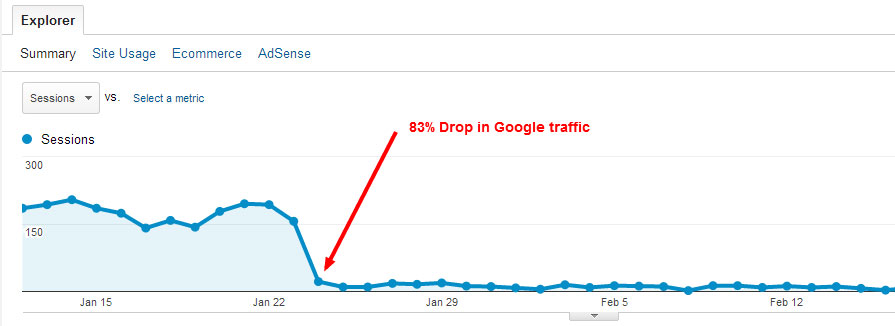
It is not just a dip, but a sharp drop-from-a-precipice traffic loss. In one night, 60 or even 90 percent of your Google traffic wiped out. Suddenly, your site is nowhere to be found in Google. When you search for your domain name, you can see in the search results mentions of your business from other sites and your social media profiles — but not your domain! Your website has disappeared in Google.
It’s the nightmare of every website owner — more so for those that rely on the search engines to get traffic to their sites. If Google accounts for only 10% of your traffic, it’s no big deal. But if Google sends 80% of your traffic and Google stops sending that traffic to your site, then you are in deep trouble. And it’s a nightmare that may drag on for weeks, months, or worse, even years.
A Google algorithm slap often comes without any warning. You will only know it when it hits you. Even without seeing the full traffic numbers for the full day, you will feel the impact of losing most of your Google traffic that day as your sales dramatically slows down or advertising income feels like it is crawling. If you are an Adsense publisher, you may initially think that perhaps reporting is just delayed because your numbers fall severely short of what you are expecting for that hour. If you are running an ecommerce shop, you may think that there’s something wrong with your shopping cart or merchant account.
When your website gets hit by a Google algorithm, you are in for a roller coaster ride of emotions. First, there’s the guarded sense of dread as you notice a sudden drop in sales, or even people contacting you. Then there’s the shock and disbelief. This emotion will then be followed with cries of, “Why me? What have I done?” Panic could ensue, and then the scrambling to find a fix to the problem.
Getting hit by a Google algorithm is painful; the traffic drop is often steep and immediate. Worse, it’s a lingering pain that you will feel for months — even years – that throwing in the towel sometimes become the most viable option. Overnight, the future of your web business is bleak. What was once a thriving business now becomes a source of headaches and pain. Whatever your business model, losing Google traffic can have a profound impact on your business.
The problem with an algorithm hit is that you may not know what exactly to fix and how to fix it. Googlw will not tell you what is wrong with your website; nor will it tell you how to fix your website. Other than general tips such as “create quality content” and “follow Google guidelines,” there’s no exact list of steps you need to follow to recover the lost traffic. It’s all going to be trial and error; and recovery may be a result of not one, but a mix of all the things you have changed in your website.
Even if you think you’ve changed a lot and done a lot, there’s no guarantee if your website will recover – and when it will recover. In fact, many of the websites hit by previous iterations of Google update have not recovered. They are still scrambling to find a way how to get their traffic back up – even after doing what they feel like to be a thorough cleanup of their sites and link profiles. You need to brace yourself.
Nonetheless, here are some things you can do when you get hit by a Google algorithm:
1. Accept that there’s something that is not quite right with your website.
This is the hardest first step. It is not easy to accept that there’s something wrong with your website or how you promote your site on the Web. Maybe your website has always been effective in converting visitors to sales, or in generating advertising income. You may also have a lot of confidence in the quality of your content or in the design of your website. Alas, the fact that your Google traffic plummeted means that Google has found something that it does not like on your site and took adverse action on it.
2. Determine what update hit your site.
The steps you can take to recover lost traffic will depend on what hit your site in the first place.
If your Google Analytics charts shows your traffic dropping from a precipice, and that majority of the traffic drop can be attributed to Google, scour the Web immediately if there were any Google algorithm updates. Check webmaster forums such as WebmasterWorld.com or SEO websites such as SEOMoz.com to read about any Google updates, as well as Google employees on Twitter such as Matt Cutts (@mattcutts). When they say that there’s indeed an update, match the dates given to the drop in your traffic.
Some of the recent updates include:
- Panda update = crack down on thin content, content farms, sites with high ad-to-content rations and other quality issues. Originally rolled out on February 23, 2011, Google has released a number of Panda updates since then, and updates now happen more frequently (“Panda Flux”) and relatively minor (but impacts to sites affected remain devastating)
- Top Heavy Update (Ads above the Fold) = released on January 19, 2012, this page layout algorithm targeted sites with too much ad space “above the fold.”
- Penguin Update = first released on April 24, 2012, this webspam algorithm targeted sites involved with keyword stuffing, cloaking, link schemes and others.
- Hummingbird = released on September 26, 2013, this algorithm focused on improving Google’s semantic search
One important thing to consider: your site could be hit by multiple algorithm changes with penalties piled on top of one another. For example, your site may be hit by Panda version 1, then hit by the Top Heavy Update, then hit again by Penguin. This makes recovery even trickier – and possibly longer.
3. Stop and take a look – very carefully – at how you operate your website
Objectively assess your website and your business practices, particularly with regards to Google webmaster guidelines and Google’s definition of quality content. Ask yourself the following questions:
- How are you promoting your website?
- How are you building links?
- Are you dropping your links in forums and blogs?
- Are you buying low-quality links?
- Aside from the links that you yourself generated, what is the quality of your external link profile?
- What is the quality of the content that you produce?
- Is your content providing value to users?
- Do you write original content or do you use article submissions from guest authors and through article directories?
- How do you present your content, particularly with regards to ads?
- How is the overall user experience?
- Does your site have any technical misconfigurations and errors?
4. Make changes to your site.
Recovering lost Google traffic is often a result of a combination of factors. There’s no magic formula where you only do a single thing and expect to recover (though I wish there was!). When you are hit by a Google algorithm, your best chance of recovery is a rethinking of your web presence, and how you run and manage your website.
Here are a number of things that webmasters of sites previously hit by Google’s algorithm have successfully tried to recover their traffic:
Fix Links
- Remove poor quality links that you have built previously
- Disavow spammy looking links (including those that you didn’t add)
- Rethink sitewide links including links to your own sites – for some sites, it won’t hurt them, while for other sites, it could be enough to get flagged in Google for “unnatural links”
- Work on getting high quality links, including earned media
- Increase engagement in social network sites, which can help you diversify your traffic source as well as generate better quality links
Improve Content
- Improve quality of content, often with denser information
- Fix or remove poorly written articles by correcting grammar and spelling as well as improving sentence structure
- Merge pages with thin content either by rewriting content or combining several pages of thin content
- Fix or delete bad pages based on user experience as well as those that have been copied and plagiarized from your site
- Extensively rewrite articles you have previously shared with article submission sites and guest blog directories
- Add new pages with high-quality content
Improve User Experience
- Rethink and improve website design, with a focus on improving user experience
- Improve page loading
- Make your site responsive for mobile
- Revamp navigation structure
Fix Technical SEO Issues
- Fix any over-optimization of the site
- Improve coding of the site to make it more W3C compliant
- Remove any authorization permission errors
- Add microdata
- Correct improper use of noindex tags
- Fix soft 404 issues
- Fix canonicals
- Fix daisy chaining of 301 redirects – just go from Point A to Point B in one jump if possible
- Fix any canonical issues
As a website owner, you cannot be complacent and think that what works today will still work tomorrow. Google is constantly changing its search algorithms in order to give their users the “best results” (often debatable) for their queries. The things that worked today with Google – and for you – may spell the death of your website later on.
As a website owner, you cannot sit and be complacent on the Web. As Google constantly evolves, it is important that you also find ways to improve and to innovate your website with the goal of giving your customers the best experience while generating the revenues you need. Only by doing so can you prevent dramatic traffic fallouts from Google.
