Key Takeaways
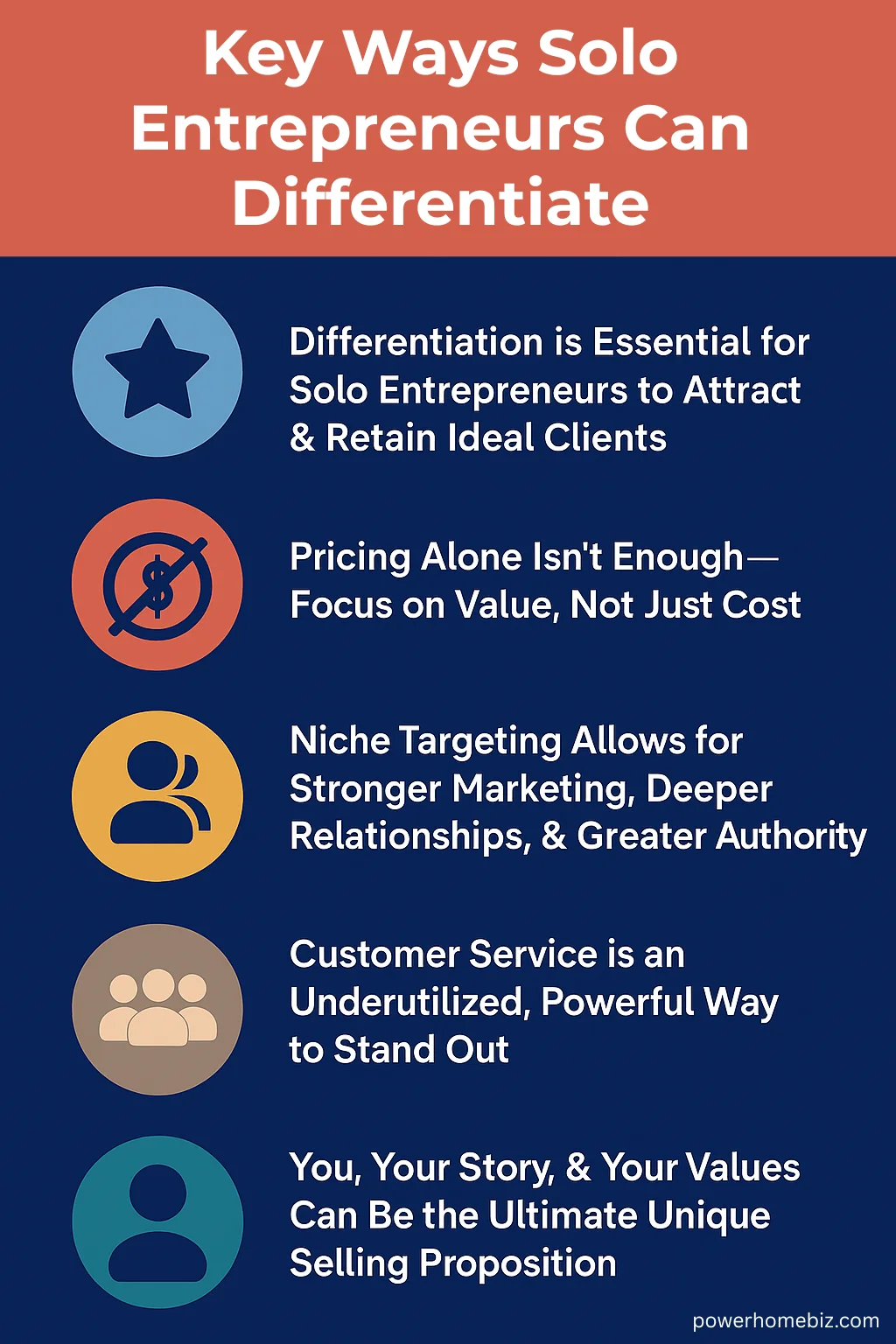
- Differentiation is essential for solo entrepreneurs to attract and retain ideal clients.
- Pricing alone isn’t enough—focus on value, not just cost.
- Niche targeting allows for stronger marketing, deeper relationships, and greater authority.
- Customer service is an underutilized, powerful way to stand out.
- You, your story, and your values can be the ultimate unique selling proposition.
Have you ever stumbled when a potential client asks, “So, what makes you different?” You freeze, not because you don’t believe in what you offer, but because you haven’t fully articulated your edge. You’re not alone. Many solo entrepreneurs struggle with this crucial part of their business identity.
Differentiation is more than a business buzzword—it’s your ticket to being remembered, recommended, and rewarded. When done right, it boosts your confidence and makes your marketing sharper and more impactful. In an era of digital saturation, solo entrepreneurs who clearly communicate how they’re different stand out—and win.
Let’s explore the four core types of differentiation and how you can leverage each one to grow your business.
Table of Contents
What Does It Mean to Differentiate?
To differentiate in business means to offer something that customers perceive as more valuable than what your competitors provide. It’s not about being different for the sake of it—it’s about standing out in ways that matter to your customer. Think of terms like:
- Unique Selling Proposition (USP)
- Value Proposition
- Competitive Advantage
These aren’t just jargon—they’re your marketing lifelines. Customers make fast decisions, and clarity in how you solve their problems better than anyone else helps them choose you.
1. Price Differentiation: More Than Just Lowering Costs
Price differentiation is the most instinctive strategy, but it’s also one of the riskiest—especially for solo entrepreneurs. Many assume that offering lower prices is the easiest way to compete, but cheaper isn’t always better in the eyes of your audience. Low prices can signal low value, which is the last thing you want when you’re building credibility.
Smarter Ways to Compete on Price:
- Add Value, Don’t Just Discount
Offer bundles, added services, or extended access to make the deal more attractive. - Freebies & Extras
Include complementary products, digital downloads, or future-use coupons. - Free Shipping or Local Delivery
Convenience matters—and offering it can justify your pricing. - Strategic Discounts
Offer sales or coupons occasionally, but tie them to events or holidays to retain value perception.
Key Insight: Competing on price works best when it’s part of a larger value-based strategy, not a race to the bottom.

2. Focus Differentiation: Niche Down to Win Big
For solo entrepreneurs, focus isn’t a limitation—it’s a superpower. You don’t have the resources to be everything to everyone, so why not be the go-to expert for a very specific group?
When you narrow your focus, marketing becomes easier, customer relationships deepen, and your authority grows faster.
Examples of Focus Differentiation:
- Location-Specific Services = Be the local expert. Customers love nearby, accessible providers who understand the community.
- Customer Specialization = Focus on a specific type of client—new moms, small creative businesses, eco-conscious consumers, etc.
- Customer Relationships = Build long-term loyalty through transparency, responsiveness, and personal touches.
- Affinity Marketing = Align your brand with a cause, celebrity, or organization that your customers trust.
- One-Stop Niche Shopping = Become the single best provider of all things related to your niche.
Real-World Example:
A freelance designer specializing in branding for vegan food startups may charge more and attract more loyal clients than a generalist who serves everyone.
3. Product/Service Differentiation: Solve Real Problems Uniquely
You don’t need to reinvent the wheel. You just need to tweak it in a way that makes life better for your audience. This is where your ability to listen to customers becomes critical. Ask questions. Gather feedback. Use those insights to enhance your product or service.
Ways to Differentiate Your Offering:
- Superior Quality = Use premium materials, in-depth processes, or attention to detail that competitors overlook.
- Be the First or the Only = Launch a new service before competitors catch on. First movers often gain faster market traction.
- Customization = Big businesses can’t personalize the way you can. Offer personalized consultations, design options, or curated bundles.
- Solve a Specific Problem = Your service should tackle something your customer cares deeply about, in a way no one else does.
Pro Tip: Don’t be afraid to charge more when your product or service truly delivers something unique or personal.

4. Customer Service Differentiation: The Overlooked Goldmine
In today’s digital-first world, genuine, thoughtful customer service is increasingly rare. That’s exactly why it’s such a powerful differentiator. You don’t need a call center or 24/7 chat. You just need to consistently delight your customers and show them you care.
Stand-Out Service Strategies:
- Responsiveness = Reply faster than expected. Same-day responses—even if it’s just a short acknowledgment—build trust.
- Convenience Channels = Offer customer service via email, phone, Zoom, or even text—wherever your clients prefer.
- Go the Extra Mile = A handwritten thank-you note, follow-up call, or unexpected freebie can leave a lasting impression.
- Strong Guarantees = 100% satisfaction or your money back. Clear, simple return policies also reduce buyer hesitation.
- Access to You = Make yourself available (within boundaries). Your presence is a big part of your value.
Keys to Successful Differentiation
Differentiation isn’t something you do once and forget. It’s an ongoing strategy that requires clarity, customer insight, and intentional communication. Even the best product or service can go unnoticed if you don’t clearly show how it’s different—and why that difference matters. The goal isn’t just to stand out, but to stand out in ways that feel relevant and valuable to your audience. Below are the essential principles that will help you not only define your unique edge, but also make sure it resonates, evolves, and drives real business growth.
- Know Your Customers Intimately = Research their pain points, values, preferences, and behavior.
- Pick Differentiators That Truly Matter to Them = What you think is special doesn’t matter if your customer doesn’t care about it.
- Communicate Benefits, Not Features = Don’t say, “I offer 15 design templates.” Say, “I help you launch your website faster so you can make sales sooner.”
- Be Consistent but Adaptable = Your differentiator should be easy to recognize but evolve as your customers’ needs change.
- Promote Your Difference Everywhere = Include it in your bio, pitch, website, social media, email signature—even your invoices.

Humanizing Your Brand: You Are Your Best Differentiator
Here’s the truth: You’re part of the product. People don’t just buy your services—they buy you. Your style, personality, values, voice, and vibe all matter. Solo entrepreneurs have a huge opportunity to be relatable and real, which builds faster trust and loyalty.
Use storytelling, behind-the-scenes content, and values-driven messaging to connect emotionally. Don’t try to be a faceless corporation. Let your personality shine—because no one else can be you.
FAQ on Differentiation
What is the most important type of differentiation for a solo entrepreneur?
The most effective differentiation strategy for a solo entrepreneur is focus differentiation. Why? Because limited resources mean you can’t serve everyone. Specializing in a niche market allows you to develop deeper expertise, attract highly targeted leads, and become the “go-to” authority in that space. This creates natural loyalty and better word-of-mouth referrals. Focus also simplifies your marketing, as your messaging becomes more specific, relatable, and effective. It’s much easier to be memorable when you serve a clearly defined audience with a unique value that solves their specific problems.
Can solo entrepreneurs charge higher prices with strong differentiation?
Yes, and they should. Strong differentiation means customers perceive your offer as better—not just different. When you’re seen as the best-fit solution to a problem, price becomes a secondary concern. For example, a life coach who specializes in burnout recovery for female tech founders can charge more than a generalist coach. Why? Because she deeply understands her clients’ pain and offers a tailored solution. Differentiation justifies premium pricing, reduces price objections, and improves profit margins—all crucial for solo entrepreneurs trying to scale sustainably.
How do I know if my differentiation strategy is working?
The best indicators are conversion rates, referrals, and customer feedback. Are people visiting your website and reaching out to work with you? Do you get comments like, “You were exactly what I was looking for”? Are your existing clients referring others? If yes, your strategy is likely working. You should also survey clients and review testimonials to spot recurring themes—these are clues to your perceived strengths. If you’re struggling to get attention or losing leads to competitors, it may be time to revisit your messaging and positioning.
How can I talk about my differentiation without sounding arrogant?
Great question—and a common concern. The key is to frame your difference around customer benefits, not personal ego. Instead of saying, “I’m the best web designer in town,” say, “I help small businesses launch websites that attract clients in under 30 days.” Focus on results, not boasting. Use client testimonials and case studies to show, not tell. When you speak in terms of how you solve problems or deliver results, your confidence will come across as helpful—not pushy.
Can I combine different types of differentiation?
Absolutely—and it’s often the most powerful approach. For example, you might focus on a niche market (focus differentiation), deliver a unique version of your service (product differentiation), and pair it with outstanding follow-up (customer service differentiation). The combination creates a layered, compelling offering that’s hard to compete with. Just make sure the strategy remains coherent and doesn’t confuse your audience. Every element should support a clear, central message: why you’re the best solution for their needs.
Recommended Books on Differentiation:
- The Power of Differentiation
- Sales Differentiation: 19 Powerful Strategies to Win More Deals at the Prices You Want\
- Fast Innovation: Achieving Superior Differentiation, Speed to Market, and Increased Profitability: Achieving Superior Differentiation, Speed to Market, and Increased Profitability
- Differentiate or Die: Survival in Our Era of Killer Competition
- Positioning: The Battle for Your Mind
This article was originally published on June 15, 2013, and updated on June 21, 2025.