
People are shifting to online channels, and thus, many companies choose to join forces differently. The challenge is identifying the opportunities and partnerships that maximize revenue and help attract customers. However, the top video providers are in a hurry to exploit the opportunities.
The OTT streaming sector in India is projected to increase to 13 to 15 billion over the next decade at 22 to 25% CAGR. The over-the-top sector is constantly growing and is the most competitive, with 40 players representing all types of content providers.
Table of Contents
It has been led by “strong tailwinds” from enablers being in place for video streaming like affordable high-speed mobile internet; the number is double that of internet users in just six years. However, it has also helped India-specific points provided by global players like Prime Video, Netflix, and Disney+. They all offer 70 to 90% of plans in India, which is relatively cheaper than in the U.S.
The OTT sector is witnessing a steady growth in investments; this has led to increasing hours of original content users enjoy. Strong content helps capture eyeballs outside. The OTT satisfies international demand by targeting the markets that have language similarities.
OTT Streaming: Top Trends and Predictions for Entertainment Sector
Undoubtedly, content distribution, consumption, and generation are disrupting television. Over-the-top media revenue is forecasted to increase and reach around 210 billion U.S. dollars by the end of 2026. The number is more than 106 billion, which was measured in 2020. The service measured drastic growth over the past few years, with revenue increasing steadily from 6.1 billion U.S. dollars in 2010 to nearly ten times that amount in 2020.

The number clearly shows that the internet gradually overtakes TV as the standard way most people consume media. Mushrooming acquisitions and partnerships are reshaping the video media landscape. Ideal partners, particularly among traditional mobile network operators and OTT video providers, are competing for collaboration to grasp the greatest market share, creating business alliances and constantly maturing product offerings.
The greatest challenge lies in comprehending what offerings to initiate and whom to partner with to increase revenue while gaining more customers. Let’s look at transforming trends that are changing the global landscape and play a crucial role in informing the strategy that ecosystem players must choose to succeed.
Experiment with New & Effective Models for Content Monetization
The on-demand content market is evolving steadily, and many companies are also experimenting with new and effective models for content monetization. One of the most popular models is subscription video on demand (SVOD) and advertising video on demand (AVOD).
More than 75% of movies on SVoD services as of January 2021 were from the drama category. Drama films made up the majority of content on AVoS channels. When it comes to television, nearly 52% of content on AVoD was comedy shows, compared to the figure for SVoD, which is around 44%.

Customers are spending more on an SVOD platform like Netflix and Amazon Prime Video. It is considered the largest video services payment method at 51% of global spending. Transactional video on demand, including digital rental and electronic sell-through, still offers more than half of OTT services.
Strategic and Consolidations Partnerships are Changing the Ecosystem
With competition intensifying and greenfield expansion becoming challenging, the market is growing with M&A talks and partnerships with those seeking to expand into new markets or differentiate themselves.
Some of the top examples include T-Mobile, Netflix’s streaming partnership, Verizon’s purchase of Yahoo, and Amazon’s Prime Video, which features content from Showtime, HBO, and Cinemax.
Changing the Value Chain of Content Distribution and Creation
Streaming television is touching most of the corners of media, disrupting how content is distributed, how it is created, and by whom it is being created. Today, almost 50% of OTT viewing households Have an HHI of at least $75K; they consume in the same manner as traditional T.V. viewers.
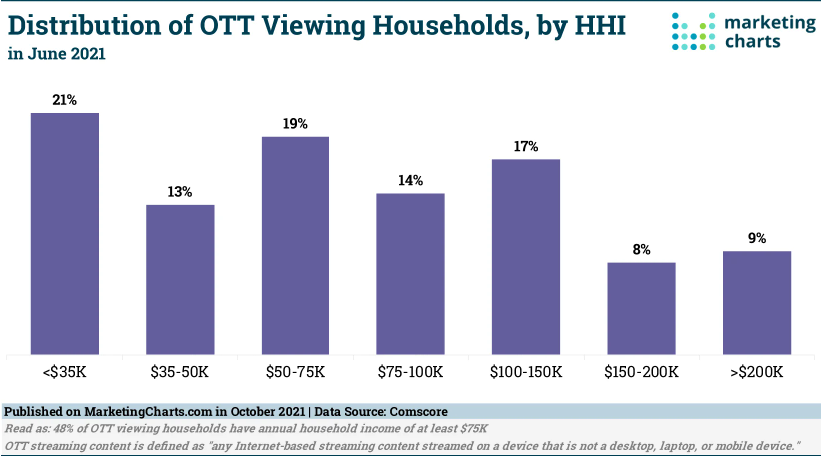
More TV viewers are opting for internet-based distribution. Hence, brands are developing a video streaming script to cater to viewers’ growing needs. The majority of U.S. households are consuming T.V. programs via traditional bundles. Moreover, customers are spending more on home entertainment. The trend is predicted to increase steadily.
MNOs Play Crucial Role in Cord-cutting Accelerates
Mobile channels are being accepted mediums for video delivery and have overtaken traditional T.V. as the leading growth channel. With TV billing arrangements as well as fixed broadband binding, mobile is considered as dominating the growing channels for service distribution.
MNOs are also accelerating LTE deployment and mobile broadband, while access to high-quality mobile streaming is growing, especially in Africa, the Middle East, and the Asia Pacific markets. The surge in MNO bundling and partnership deals incentivizes audiences to consume more content on their smart devices.
OTT Streaming: Join the Racing Toward the Future
The above-listed trends are undoubtedly affecting the media ecosystem in different ways. Some are experiencing maturing markets, while others are experiencing fresh opportunities to evolve to a new industry standard for service delivery and products. All the OTT providers are in a hurry to exploit engaging opportunities, and agile ecosystem partners will join them in this pursuit.