Most startups begin with a dream that transforms into an idea and later, a business. For the better part, entrepreneurs have their ideas figured out. They know the amount of capital, team members, and even the audience they wish to target.
But along the way, things change. It is estimated that up to 90% of startups collapse in the first year. There are various reasons for this, and most are associated with lack of money, supportive team members, or market penetration. Fortunately, startups can avoid collapsing by checking for tell-tale signs.
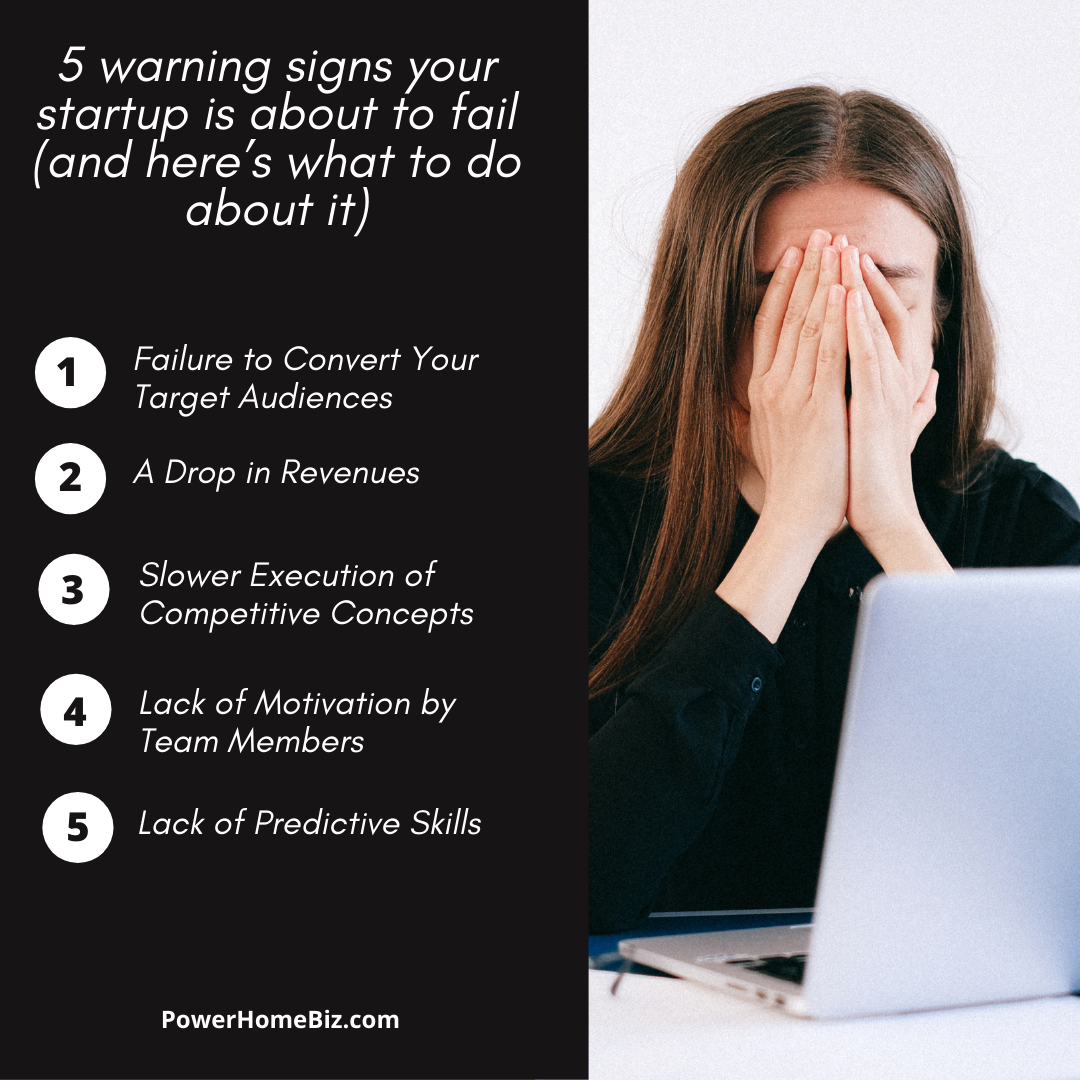
This article will share the 5 warning signs your startup is about to fail and what you can do about it.
1. Failure to Convert Your Target Audiences
When starting a business, one of the most important aspects to focus on is your target audience. This is because your target audience determines your level of market penetration in a competitive environment.
But at times, converting your target audience to return customers turns into an impossibility. This mostly happens if your marketing strategies are not reaching the right crowd. It could also happen when you are attracting the right audience but don’t understand their pain points.
To better understand your audience, you have to turn back to where it all began. If you had previously carried out market research, confirm that your plans and activities are working. If you have not done market research, then this is the time to do it.
It’s also important to confirm if the products and services you are delivering are what the clients are looking for. By simply carrying out a survey, you can segment your deliveries based on demographics, location, and interests.
Alternatively, hire a startup marketing agency to boost your business operations. One of the benefits of hiring an agency is that they understand current markets. They also know startup branding concepts that will improve your visibility. If you are a hype brand with specific customers, having a startup marketing company will attract and convert the right customers.
What’s more, is that agencies have ideas of how much a startup should spend on marketing. So, if you have been spending more than you should, they’ll help you correct the figures. Agencies also offer startup marketing plans to cover your digital expectations over long periods.
2. A Drop in Revenues
Revenue is the heart of any business. For both the emerging and established brands, revenue helps keep the business afloat.
Revenue is also a measure of progress, especially for startups. Most startups depend on a regular income to stay operational. This means that even the slightest drop in revenue results in a complete stop of some processes. And with time, something as important as office rent becomes impossible to keep up.
But in most instances, the revenues don’t drop instantly. There’s always a trend, with a few dollars missing every week. If you are keen on your books, then catching such figures is pretty easy.
If you notice a trend of lower numbers, it’s important to confirm the cause. Check the overheads, employee commissions, and even social media analytics to determine the reason. After finding the cause, you can then employ mitigative measures to ensure the losses don’t reach alarming levels.
If, for instance, your social media marketing strategies are what’s causing the drop, you can rethink the strategy. For example, if your initial strategy does not include a social media manager, you may look for a way to introduce one. Just like the products, social media engagements are equally as important for conversions. A lack of either can result in a drastic drop in revenues.

3. Slower Execution of Competitive Concepts
If you want to grow your startup, you need to be competitive in the markets. A competitive market allows for innovation and also the growth of a brand.
If you also discover that competitors are always catching you unawares with innovative ideas, it means you are not in touch with current trends. And when this happens, your past, current, and future goals will never align.
To keep up with the competitive market, revise your goals. Look at what you have achieved, what has failed, and which plans need to go. If you have diverted from your initial goals, find a way to get back on track.
Please note that as a startup, running many concepts at a go may not work. It’s important to focus on individual paths. Running one single project at a time gives you time to grow and penetrate competitive markets.
It’s also important to know who your competitors are so conducting a competitor analysis is of the utmost importance. Being able to see what your competitors are doing well and analyzing their areas for improvement can give you a big boost. This benchmarking will give you more ideas on how you can get ahead of your competitors.
4. Lack of Motivation by Team Members
One of the biggest contributors to the success of a startup is the support of team members. The employees, directors, and suppliers play a big role in the growth of your brand. Therefore, having a conducive work environment is a good start in motivating the team to scale your business.
But a lack of motivation by team members means something is wrong. In some instances, it can be work monotony that brings boredom. It could also be the lack of innovative ideas to keep their minds jogged up. Often, team members will notice when the business fails and lack the motivation to put in more effort.
Also, if you offer no chances for the team members to share ideas, you make it difficult for them to contribute to business growth. Keep in mind that for a business to thrive, every team member should have the chance to share their thoughts.
This can be through something as simple as a brainstorming session where team members discuss ideas and share opinions on future expectations. Just like established businesses, startups need regular meetings to ensure members share a common goal.
5. Lack of Predictive Skills
A business cannot thrive on strict approaches. There are times when a thing or two needs to change for the business to flourish. If you find that your business goals are fixated on a specific approach, this is a sign of eventual downfall.
For a startup, your survival tactics depend on how predictive you are of the current market. It relies on flexibility to change decisions when the current ones aren’t working. Often, you’ll have to become more creative to evade the troubles. Other times, you have to sit still until you are sure that it’s safe to make a move.
Your focus should always be on approaches that minimize losses and eventual collapse of the business.
Final Thoughts
Not everything is colored in black and white in business. While some ideas may grow your startup to international levels, the same idea may pull another to the ground.
A point to note is that you have to be very predictive of your environment. It’s important to learn what works and what you should change to ensure the continuity of your business.
It’s a fact that most startups fail in the first and second years. It’s also true that learning the reasons why could change the course of your business.