

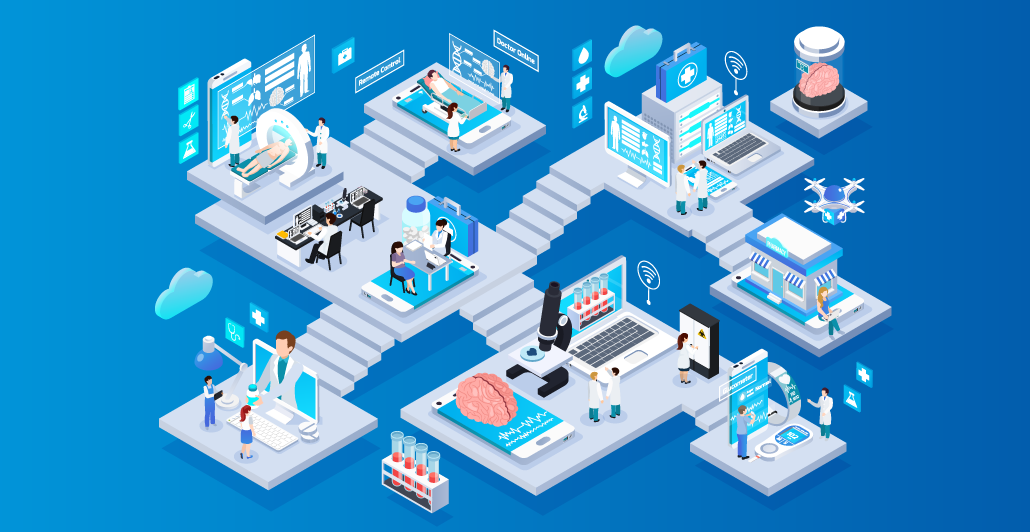
Whenever we talk about the application of the Internet of Things in the healthcare sector, it shows a picture of smart sensors and hospitals with the latest technologies. But you might be in a state of fascination to know that it goes beyond this. And there are even many challenges of IoT in healthcare. According to a recent survey, expenditure on IoT solutions in the healthcare sector will attain the amount of $1 Trillion by the end of 2025.
Table of Contents
The Internet of Things will help the healthcare sector impart customized, accessible, and best-in-class treatment to patients. And all of these will be at a certain low cost. IoT healthcare benefits have come a long way, from helping treat patients remotely to transmitting real-time signals. This text will help. You understand its importance and know Iot in healthcare app Use Cases.
IoT in Healthcare: Benefits
IoT holds enormous potential to transform the landscape of healthcare in innumerable ways. The invention of wearable technology that can collect information such as heart rate, activity level, and other crucial data has greatly helped. Collecting all these data can help you know the symptoms of illnesses early, if any. Also, with this technology, you can check patients remotely. Hence this ensures better healthcare access for people in difficult areas to reach out to.
Also, IoT is responsible for improving how doctors utilize devices for diagnosis and treatment. Medical devices are connected to a network for sharing data in real-time. Hence this facilitates accurate diagnosis of patients to provide better treatment. Also, it provides enough time for the doctors to speak with the patients.
What are the challenges and opportunities for IoT in healthcare?
1. Data Security
The major challenge that IoT in healthcare faces is security. Data is a valuable asset in the medical industry because a patient’s medical history is highly confidential. If any malicious data is exposed to a company’s software, it can be harmful. If you choose a great developer for IoT app development, it can help you remain safe from any data theft in the future.
One of the IoT in healthcare benefits is that it can help you enhance data security and prevent any issues that arise in the future. Also, certain costs come additional with this security. On IoT-connected healthcare applications, GDPR and CCPA can be utilized to protect the patient’s data. Complying with the security requirements will not only let you prevent the leakage of sensitive data but also heavy fines.
2. Integration of Protocols
Different medical devices based on the Internet of Things are connected through IoMT. The healthcare industry needs various types of devices that work on different protocols. Hence this generates a flexible environment. There is no ideal choice in terms of communication and standard protocols. Therefore the integration of IoT in the healthcare sector is at a slower pace.
If you are developing medical software, ensure it complies with HIPAA and HITECH. Various rules are associated when you want to process a patient’s data. It can be one of the major challenges of IoT in healthcare. Choose an IoT company with the expertise to help with the best results.
3. Data Overload
Medical devices based on IoT are responsible for gathering and processing data in tonnes. It can lead to arousal of problems like less accuracy and overload for doctors. Hence the integration of IoT can help in tonnes of ways. It can help generate details to cater to the best treatment.

What are some usage cases of IoT in healthcare?
1. Remote Patient Care
Many places don’t have hospitals. And in an emergency, it takes a lot of time for them to reach out to healthcare professionals. Also, on the other hand, it gets tough for healthcare professionals to converse with patients that face serious illnesses now and then. Hence, this commuting issue is time-consuming and can only be tackled with remote patient care featured with IoT.
This innovation can assist healthcare professionals in checking the patient and prescribing medications from their place. Also, they can measure all necessary data with the help of biometrics and remote devices. Patients can try connecting any wearable to the cloud, where real-time reports of patients will be added. This is especially true with teleradiology services and similar areas.
Also, there are IoT devices that can help patients have Facetime. This feature will help an expert prepare a detailed care plan per the patient’s detail until they can visit physically. They might also need not visit the hospitals. And this video call facility can be more helpful for chronic patients as it provides daily health updates. Also, the data they collect from charts and diagrams will be easy to visualize for professionals. Video and audio calls could help doctors monitor patients’ improvements without commuting to their place.
2. Emergency Care
The output that one will get from emergency care will always depend on accuracy, time, and information. Also, the information It receives while on an emergency call will affect the quality of treatment given to the patient. A healthcare facility provider collects the necessary information while the patient goes to the hospital.
The entire procedure behind gathering, storing, and processing data is time-consuming and tiring. But the application of IoT could help you collect accurate data that can be used by emergency care people in the ER. An IoT development company will empower you with technology that provides faster and better medical facilities. Also, ER staff can access this real-time data before the patient reaches the hospital. It will let you prepare for care before the patient arrives.
3. Tracking of Inventory, Staff, and Patients
Healthcare providers are constantly on a roll to enhance their workforce and reduce operational expenditures. This statement holds good for both huge and small institutions. All of them have staff, patients, and inventory stock. The application of IoT devices, such as wireless ID cards, can help them increase admission and enhance security. Also, to track the real-time location of the inventory, you can use BLE and RFID. It can also help you trace your faculty when it’s urgent.
Also, when IoT is combined with RTLS, it can help you track your assets. Additionally, it is the cheapest way to track your drugs, resources, and equipment. By saving time here, you can spend more time in patient care.
4. Augmenting Surgeries
IoT has made its way to even operation theaters in the healthcare sector. Can you think of a robot powered by artificial intelligence conducting surgeries? These surgeries are about bringing more precision into the world through robot-assisted surgeons.
Hence the application of IoT and connected devices will enhance the efficiency of medical staff activities in the before and after operation stages. In both stages, these sensors will help collect, analyze, and transmit the data. It will help maintain the smallest detail to prevent complications during surgery.
5. Virtual Monitoring of Critical Hardware
It is mandatory that all the new era healthcare technology has to possess hardware and software to function properly. And in case this doesn’t happen, there are chances of causing certain threats. Can you think how dangerous a power cut or system failure can be? It would be dreadful, right?
As there are no organizations that would not fear these mishaps. Hence they generally go for IoT-based solutions that are best. An example is e-Alert by Philips, which can have an eye on crucial medical hardware. If it finds a problem with any equipment, this technology will alarm the responsible hospital staff. With this, you can avoid failure through preventive measures.
6. Pharmacy Management
The pharmacy business is in millions and can be tough to work with. Many steps involve transferring and managing drugs from the company to the hospital. Also, preventive steps can help avoid issues. Here IoT can assist you with combining the best safety measures and the latest technology to ensure the drug delivery process is smooth and safe.
These days smart fridges help transmit and store vaccines. They avoid drug damage while transferring. Pharmacies that take the help of the Internet of Things will be able to provide better efficiencies, zero error medical dispensing, and the best patient satisfaction.
7. Wearables
Wearables are a trend but have taken over the entire healthcare industry. They are based on IoT and can help healthcare teams gain various patient data types. It can help them check their sleep patterns, temperature, heart rate, etc. These wearables will help them collect real-time data for better evaluation. The wearable will instantly transmit the signals to the professionals and help them provide timely assistance. It can also help monitor aged patients that are outside of hospital premises.
Conclusion
The Internet of Things has transformed how people view healthcare services. Accepting new technologies has led to enhancement in quality product development and will bring a major change in the coming time. Although IoT has plenty of challenges in healthcare, this won’t affect it anyway. This latest upgrade is bringing transformation in healthcare in a meaningful way. With the help of this modernization, hospitals can eliminate their outdated procedures to reduce the waste of time. Implementation of IoT in healthcare will help reach out to patients timely and provide the best care possible. Consider the best IoT development companies to leverage the benefits of this technology.
.
