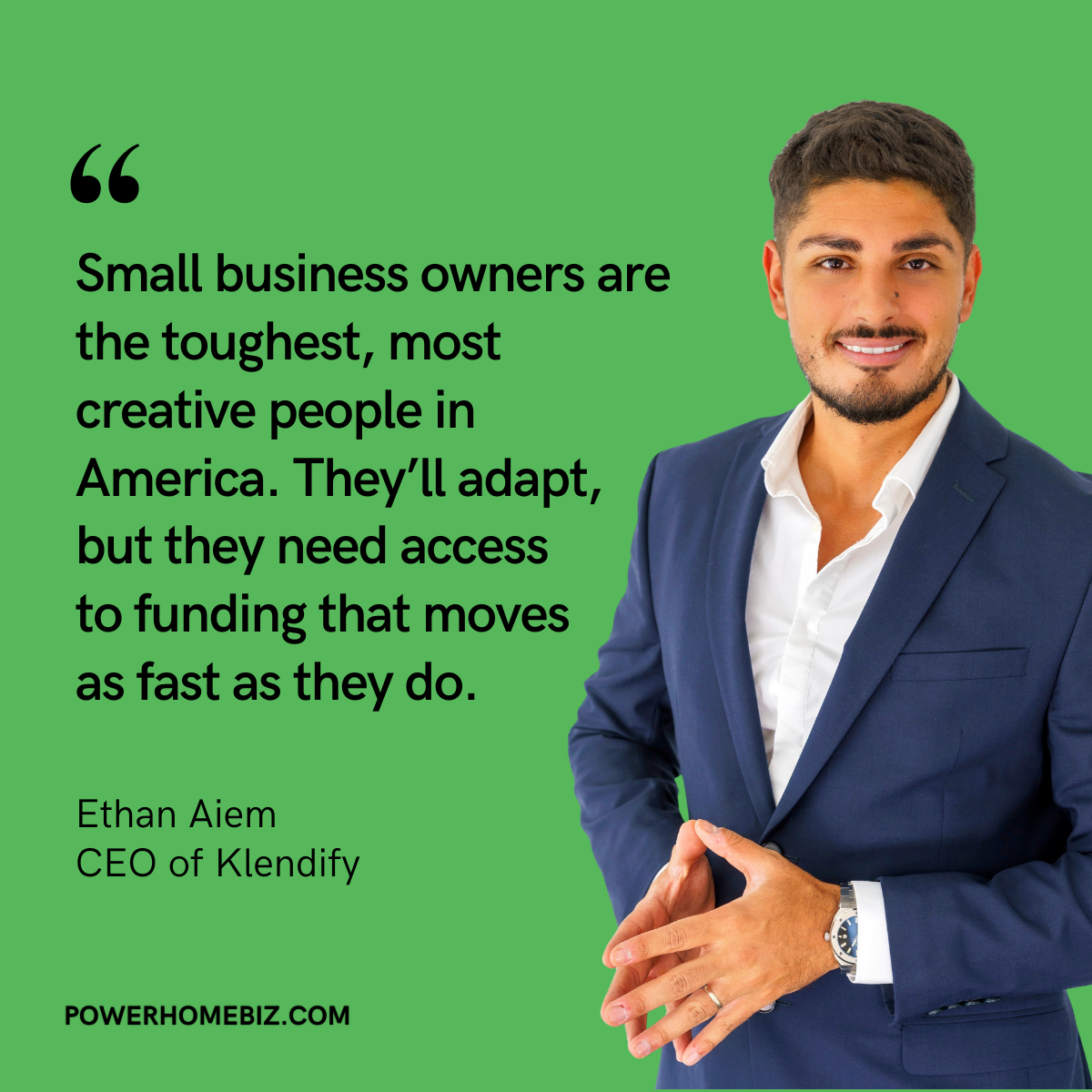
Each day the government shutdown continues, 320 small businesses lose access to $170 million in SBA-backed funding. Klendify CEO Ethan Aiem breaks down how this crisis is rippling across Main Street — erasing jobs, delaying growth, and forcing entrepreneurs to find faster, more flexible sources of capital.
Key Takeaways
- Every day the shutdown continues, Main Street loses momentum. About 320 small businesses miss out on $170 million in SBA-backed loans every single day. That’s money that would’ve paid workers, stocked shelves, or funded new projects — now frozen in place.
- The ripple effects hit entire communities. When a small business can’t get funding, it’s not just the owner who suffers. Jobs disappear before they’re even created, suppliers lose orders, and local economies take the hit.
- Banks are playing it safe — maybe too safe. Lending standards are tighter, interest rates are higher, and approval rates are dropping. Even profitable businesses are being turned away because they don’t fit a rigid checklist.
- Alternative lenders are stepping up to fill the gap. Platforms like Klendify can move faster — often funding a business in days instead of months. They look at real-world cash flow, not just credit scores, which opens doors for more entrepreneurs.
- Speed matters more than ever. For many owners, waiting 8–12 weeks for a bank decision just isn’t realistic. The ability to get capital quickly can mean the difference between seizing an opportunity or missing it entirely.
- Small businesses should always stay “funding ready.” Keep your books in order, maintain steady deposits, and build relationships with lenders before you need them. Being prepared makes it much easier to act fast when something unexpected happens.
- Not all funding options are created equal. Be careful with lenders who hide fees or make repayment terms confusing. A trustworthy funding partner should be transparent, easy to reach, and focused on helping you grow — not trapping you in debt.
- The shutdown isn’t just a pause — it’s a reset. Each lost loan means lost jobs, lost growth, and lost chances that may never come back. The lesson? Small businesses need faster, fairer access to capital — whether the government is open or not.
When Washington shuts down, Main Street pays the price.
Each day the government stays closed, an estimated 320 small businesses lose access to $170 million in SBA-backed funding. That might sound like a distant number until you break it down — it’s the restaurant that can’t open its second location, the contractor who can’t hire 10 new workers, the trucking company that can’t replace its aging rigs. Its momentum is erased before it even begins.
While policymakers debate budgets, small business owners face stalled loans, frozen approvals, and mounting uncertainty. For many, the timing couldn’t be worse — interest rates remain high, consumer demand is cooling, and traditional lenders are tightening credit standards even further.
Table of Contents
Interview with Ethan Aiem, CEO of Klendify

To unpack what all this means for Main Street, I spoke with Ethan Aiem, CEO and Founder of Klendify, a company helping small businesses access fast, flexible funding when banks and government programs can’t keep up. Aiem shared what’s really happening behind the numbers — why thousands of businesses are being sidelined, how non-traditional financing is filling the gap, and what small business owners can do right now to stay afloat during the shutdown and beyond.
1. How has the current government shutdown directly affected small business owners seeking SBA-backed loans or other federal funding? What types of businesses are being hit hardest right now?
When you break it down, $170 million a day is the difference between Main Street moving forward or grinding to a halt. Each SBA loan is often the oxygen a small business needs – it pays workers, buys trucks, stocks shelves, or funds expansions.
Here’s what that really looks like: a single $500,000 SBA loan can create 10 to 15 jobs in a contracting firm. When 320 of those loans vanish in a single day, that’s 3,000 to 5,000 jobs gone before they even exist. Stretch that over a month, and you’re looking at over 100,000 jobs erased from the economy – not lost later, but lost now.
And the damage compounds. A restaurant can’t open its second location, which means cooks and waiters don’t get hired, the landlord doesn’t lease the space, suppliers don’t get orders, and the local tax base shrinks. A trucking company can’t upgrade rigs, which means drivers sit idle, deliveries get delayed, and manufacturers can’t get goods to market. These are ripple effects that touch entire communities.
The hardest part? Many of these opportunities can’t be recaptured. If a retailer misses holiday season inventory, that revenue is gone forever. That’s why the shutdown isn’t just a pause – it’s an eraser wiping out growth, jobs, and momentum every single day.
2. The SBA says 320 small businesses lose access to $170 million in funding each day of the shutdown. What does that mean in real-world terms for Main Street businesses?
It means about $170 million worth of projects, payrolls, and purchases don’t happen every single day. That’s thousands of jobs delayed or lost. A single $500,000 SBA loan could keep 20 employees working and allow a contractor to bid on a new project. Multiply that by 320 businesses a day, and you start to see the domino effect on local economies.
3. You’ve said mainstream funding sources are under-serving small businesses. Why are banks tightening lending standards so much — and is it justified?
Banks are protecting themselves in an uncertain economy. Interest rates are higher, regulations are tighter, and risk departments have the final say. But the irony is that small businesses need capital most in times like this. The standards have become so rigid that viable, profitable companies are being denied because they don’t check every box. I’d say it’s more about banks protecting their balance sheets than supporting America’s entrepreneurs.
4. What advantages do alternative financing platforms like Klendify offer that traditional banks simply can’t match, especially during times of government uncertainty?
The biggest difference is speed and flexibility. Traditional SBA or bank loans can take 6–12 weeks to process. In that same time, we’ve already funded dozens of businesses. A Main Street business doesn’t have the luxury of waiting three months to cover payroll or buy inventory – they need capital this week.
Another advantage is how we underwrite. Banks lean almost entirely on credit scores, collateral, and rigid formulas. At Klendify, we evaluate real cash flow, daily deposits, and payment history. That allows us to approve business owners who are profitable and growing but don’t fit a bank’s narrow box.
I’ll give you a practical example: a retailer who sees holiday demand spike. A bank might take months to underwrite, by which time the season is over. We can fund them within days, allowing them to stock shelves in time to capture sales. That speed can be the difference between record profits or a missed season.
In uncertain times – whether it’s a government shutdown, a pandemic, or supply chain shocks – that ability to move fast and look beyond FICO is what keeps businesses alive.

5. Can you share a specific example of how a small business has used non-traditional funding to stay afloat or grow when traditional lenders said no?
One of our clients – a mid-sized manufacturer – was denied by their bank because they didn’t meet collateral requirements. We helped them secure $250,000 in working capital in less than a week. That money covered payroll and raw materials for a large order they otherwise would have had to decline. Within six months, their revenue grew by 30%, and they’re now a repeat client.
6. Even before the shutdown, 30–40% of small businesses were denied financing. What’s driving this systemic problem, and how can small business owners prepare themselves to be “funding ready”?
The system isn’t designed for small businesses. Banks prefer lending to bigger, lower-risk clients. Meanwhile, many small business owners don’t have perfect credit, or they reinvest profits instead of letting cash sit in the bank. To be funding-ready, owners should keep clean financial records, monitor credit scores, and maintain steady deposits. It’s not about being perfect, but about showing consistency and discipline in your operations.
7. Interest rates are now several percentage points above prime. How is that affecting small business borrowing behavior, and what creative funding strategies are you seeing emerge?
Business owners are being more strategic. Instead of taking large, long-term loans, many are opting for smaller facilities or mixing products – like pairing a line of credit for day-to-day expenses with invoice factoring for faster cash flow. We’re also seeing more seasonal borrowing, where owners borrow only when demand spikes and repay quickly to minimize interest.

8. Some critics say alternative lending can be risky or costly. How can business owners make sure they’re choosing legitimate, sustainable funding options?
Transparency is key. A reputable lender or broker will lay out all costs clearly: the repayment schedule, total cost of capital, and terms in plain language. If anything feels hidden, that’s a red flag. The right funding partner should structure financing that supports growth – not put the business in a cycle where debt becomes a burden.
9. If the shutdown continues, what do you foresee happening to small business lending overall in the next few months — both in volume and approval rates?
Bank approvals will drop even further, and demand for alternative financing will accelerate. We’re already seeing an uptick in applications from businesses who previously only considered SBA or traditional bank loans. If the shutdown drags on, I think we’ll see alternative financing go from being the “backup plan” to the first choice for many small business owners.
10. What’s your advice to small business owners right now who are caught between needing immediate capital and facing a tightening credit environment?
Don’t wait until you’re in a crunch. Explore your options now, even if you don’t need funds today. Build relationships with lenders who understand your business model and can move quickly when you need them. Having capital pre-approved gives you leverage – it’s the difference between grabbing an opportunity and watching it pass by.
Conclusion
As the shutdown drags on, it’s clear that small businesses aren’t just collateral damage — they’re the backbone of the economy feeling the squeeze first and hardest. For many owners, waiting weeks or months for government funding simply isn’t an option.
But amid the uncertainty, Ethan Aiem believes there’s also a turning point. “Small business owners are some of the most resilient people in America,” he says. “They find a way to adapt, whether that means cutting costs, finding creative capital, or reinventing how they operate. The challenge now is making sure they have access to tools and funding that move as fast as they do.”
If anything, this shutdown serves as a reminder that speed, flexibility, and preparation aren’t luxuries — they’re lifelines. Whether through traditional lenders or innovative platforms like Klendify, the small businesses that plan ahead and stay funding-ready will be the ones that don’t just survive this moment, but come out stronger.

FAQs on the Impact of Government Shutdown on Small Businesses
How does a government shutdown affect small businesses?
A government shutdown directly impacts small businesses by freezing key federal programs that many depend on — especially the Small Business Administration (SBA). When the SBA closes, new loan approvals, disaster assistance, and certain certifications all pause. This prevents thousands of entrepreneurs from accessing the capital needed to pay employees, purchase inventory, or expand operations. Businesses that rely on federal contracts also face payment delays, while others experience supply chain interruptions or slower government approvals. Even short shutdowns can create long-lasting damage by erasing opportunities and eroding confidence among lenders and consumers alike.
What happens to SBA loans during a government shutdown?
During a government shutdown, the SBA stops processing new loan applications and approvals because many of its staff are furloughed. That means lenders cannot finalize federally backed loans, even if the application was already in progress. According to the SBA, each day of closure prevents around 320 small businesses from receiving $170 million in guaranteed loans. These delays can derail major projects or hiring plans and, for some businesses, lead to missed revenue cycles. Once the government reopens, it can take weeks or months for the backlog to clear, further prolonging the pain for small business borrowers.
Which types of small businesses are hit hardest by a shutdown?
usinesses that rely heavily on SBA loans, government contracts, or regulated approvals are hit the hardest. This includes contractors, manufacturers, transportation companies, and startups that depend on working capital loans or export assistance. Service-based businesses such as restaurants or retailers can also suffer indirectly when their customers — like federal employees or contractors — lose paychecks and cut spending. The longer the shutdown lasts, the more ripple effects spread through local economies. Even businesses with no direct federal ties can experience slower sales or delayed payments from clients affected upstream.
What can small business owners do to stay financially stable during a shutdown?
Preparation and diversification are key. Small business owners should maintain up-to-date financial statements, reduce unnecessary expenses, and build an emergency reserve that can cover at least two to three months of operations. Establishing relationships with multiple lenders — including local banks, credit unions, and reputable alternative financing platforms — ensures more flexibility when one channel closes. It’s also wise to explore state or local funding programs that aren’t dependent on federal budgets. Finally, clear communication with employees, suppliers, and customers helps preserve trust and keeps operations running as smoothly as possible.
Are alternative financing options safe for small businesses?
Yes, many alternative lenders are legitimate and can be a lifeline during shutdowns — but caution is essential. Reputable platforms are transparent about fees, repayment terms, and total costs. Business owners should always review the annual percentage rate (APR), compare multiple offers, and avoid loans with hidden charges or daily repayment structures unless they have steady cash flow. Alternative financing works best when used strategically for short-term needs or growth opportunities. When paired with solid financial planning, it allows businesses to stay agile while waiting for traditional credit channels to reopen.
About Ethan Aiem, Chief Executive Officer & Founder of Klendify
Ethan Aiem is the Founder and Chief Executive Officer of Klendify, an alternative financing platform empowering businesses across the United States to access capital quickly and transparently. Since launching Klendify, Ethan has led the company’s rapid growth, building partnerships with dozens of financial institutions and lenders, supporting entrepreneurs with innovative funding solutions that fuel business expansion.
An entrepreneur from a young age, Ethan has launched and scaled ventures across financing, digital marketing, and consulting . His track record includes founding and operating multiple businesses since 2017 developing strategies that generate consistent results for clients and partners.
His leadership is defined by discipline , resilience, and adaptability, qualities that have shaped Klendify’s culture of trust and results. Today is focused on scaling Klendify into a national leader in alternative financing while continuing to mentor and support business owners every day.
Ethan represents a new generation of global entrepreneurs building bridges between markets. His vision is to enable small businesses to thrive by giving them access to the same financial opportunities as larger corporations, to create lasting community impact.