

Forex trading is a leveraged activity. Price movements in forex are very small; usually in the order of 4 or 5 decimal places. On a typical trading day, you may hear of price movements occurring to the tune of 50 to 100 pips, which is only equivalent to 0.005 to 0.01 points. With such small price movements, a trader has to use very large capital to be able to produce any kind of appreciable monetary gains in an unleveraged market. For instance, assuming the forex market was un-leveraged, a gain of 0.005 points can only translate into $500 in gains if $100,000 is invested
This is why leverage was introduced into the markets. It is provided by brokers to enable their traders trade the lot sizes that can produce reasonable returns without having to come up with the full amounts required for such trades. So with a leverage of say 1:100, you do not need $100,000 as indicated in the example given in the previous paragraph. You only need 1/100th of that amount (i.e. 1% margin) or $1000, and if you make a gain of 0.005 points, you would still bank your $500 as if you traded with the full amount. But here’s the catch: leverage is a two-edged sword. You can also lose money as if you were trading with the full amount. So if you were to lose 0.005 points, you’ve lost $500 or half your margin capital!
Some countries have taken steps to limit the leverage that brokers can provide to so-called “unsophisticated” investors, as a result of the abuse and misuse of leverage over the years. In Europe, we now have the ESMA rule which limits leverage to 1:30, and we have a leverage limit of 1:50 in the US as a result of 2010’s Dodd-Frank Act. This means that trading in these areas is virtually limited to those with loads of money to burn. But there are still jurisdictions that offer high leverage.
So there is now a clear distinction among forex brokers.
- There are “low leverage FX brokers”, who limit leverage provisions to traders. You will find them in the US, UK, Europe, Canada, Japan, Singapore and Dubai.
- You also have the “high leverage FX brokers”, who typically provide leverage that is as high as 1:1000.
Using High Leverage in FX to Your Advantage
This section talks about how to use high leverage in FX trading to your advantage. This is an attempt to describe how it can be done.
There has been a lot of talk about how the use of high leverage is dangerous, how it magnifies losses and how it is a major cause of traders losing money. I daresay that high leverage in itself is not the problem, but how it is applied by traders. After all, a sharp kitchen knife can be used to create the best culinary masterpieces when put in the hands of some of the best chefs like Gordon Ramsay, but in the hands of serial killers, it can become an object that brings death and a lot of grief to many people. So it is not about the tool itself, but the application to which that tool is put.
So it is with leverage. Besides, the use of low leverage in itself does not guarantee trading success in any way. It may even be a snare to the trader, because low leverage forces the trader to capitalize the account with large amounts of money, which can easily be lost if the trader is inexperienced. Forget about the mantra of using only “money you can afford to lose”. My interaction with traders has shown that many of them do not even trade with so-called “non-essential” funds. So why not use less money and more leverage with the high leverage FX brokers, and make some sense out of it?
Lower Risk Exposure, Lower Targets, Potentially More Money
Let us assume a trader named John has $5,000 at his disposal. If John uses his $5000 capital to trade a Mini Lot on a 1:30 leverage broker (i.e. 3% margin), he would need at least $300 for this trade. A mini lot is worth $10,000; coming up with 3% of this amount as margin would mean that John requires 6% of his capital. A 6% exposure is totally against the rules of risk management. John would need to radically reduce his lot size to a maximum of 0.05 lots (5 micro-lots), which would require $150 as margin, to gain just 50 cents a pip. John would need to bank 500 pips just to earn $250.
But what if John had a leverage of 1:200 to work with? He would only need $50 to trade 1 Mini-lot, and he would only need to make 250 pips to earn $250. Moreover, his $50 commitment to a trade would be at 1% risk, which means John is actually taking lower risk and has a lower and far more achievable monthly profit target.
So what scenario is actually the riskier scenario here?
Backup/Recovery Trades
Using less money as margin per trade allows the trader more room to set one or two extra trades. These could serve as backup trades to take advantage of an emerging opportunity without going above acceptable maximum risk exposure levels.
The real key in using high leverage advantageously lies in picking trade opportunities with a risk-reward ratio of 1:3. This means that 1 pip is risked for every 3 pips being targeted. This requires a careful gauge of where support (for buy orders) or resistance (for sell orders) levels are and what the exit points are.
Here is a classical example.
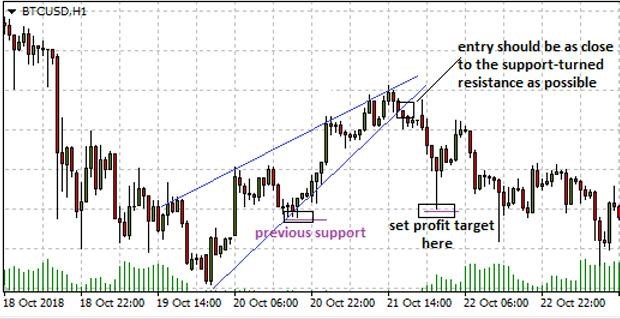
Here we have a rising wedge, which usually ends with price breaking to the south. Entry point for the short trade is specific: it has to be as close to the broken lower border of the wedge as possible. This allows the stop loss to be places at a point within the pattern that keeps things tight from the risk end.
The reward end is the tricky part; most traders simply do not know where to set their profit target. As a rule, you should use a site where price had previously formed a support as the profit target for a short trade. We can see from this snapshot that price went south and stalled at the same level of the previous support before it started turning up again. Setting a Take Profit here would produce in excess of the 1:3 risk-reward ratio being sought.
So you can use patterns, a good risk-reward ratio and properly set entry and exit points for trades, a high leverage can actually work in your favour.
