
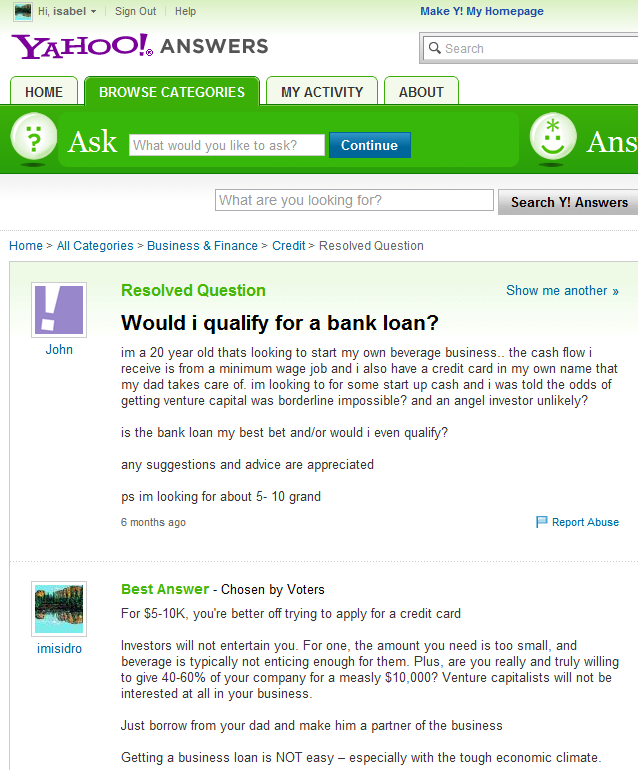
The question-and-answer site Yahoo Answers is one of the most successful social interaction communities on the Web today. With 65 million questions posted on the site, it has become a social interacting phenomenon very much like YouTube or MySpace. According to ComScore, Yahoo Answers is now the second most popular Internet reference site after Wikipedia.
Yahoo Answers is a global community of shared user knowledge. Anyone can ask a question, and anyone can answer as well – from serious questions such as how to reduce child mortality around the world to inane topics such as how to get a booty. Best of all, the site is free!
For many, the freewheeling nature of the site has made it wildly addictive; hence many find themselves spending significant amounts of time on Yahoo Answers. The site operates on a point system, where users can go from Level 1 to Level 7, in a race to be on top of the leaderboards (there are global, country and category leaderboards). The country and global leaderboards shows the users with the most number of points, which for many has become an incentive to be seen on top; while the category leaderboard shows the top 10 with the most best answers from the category.
A survey conducted by Yahoo! and Harris Interactive showed that:
- One in three online adults (33%) have used a Q&A site, and, of these, half (52%) say that information from a Q&A site has influenced a decision they have made.
- Online adults have looked for advice and reviews online and would be even more inclined to do so if the information was free and provided answers to questions in minutes.
The question for marketers and entrepreneurs now is: How can you leverage Yahoo Answers for your own business? How can you use Yahoo Answers to get traffic to your website?
Shannon Moore, General Manager of Trademark Express is currently #2 on the Business and Finance category and has been an active user of the site for more than a year. According to Shannon, “I started answering questions on Yahoo! Answers a little over a year ago and had originally thought to do so in the hopes that it’d aid in bringing in clientele … After really spending time answering thousands upon thousands of questions, other benefits heretofore unknown started popping up.”
Yahoo Answers can offer a number of benefits for your business. Here are the strategies you can use to leverage Yahoo Answers for your business:
1. Build your reputation (and your business).
Yahoo Answers is a great platform to demonstrate your expertise in your field. By answering questions in your field, you show other users that you are very knowledgeable about the topic. It is best used to build your reputation as an expert in your field, based on the quality and accurateness of your responses. The key is to respond to the questions as best as you can.
A solid reputation helps build the confidence of people to do business with you. It helps build their trust in you – that you know the topic and that your knowledge is exactly what they need. The quality of your answers can help influence whether or not other users will check out your business, or even buy your products or services.
If other users see the quality of your responses, they’d be curious to know more about you. This is where putting a link to your website in your profile is critical, as users will most likely check out your site and learn more about you.
2. Get traffic for your site.
Users who reads your answers can click on the link to your site, whether in your profile or in your answers. The more questions you answer, the more exposure you will get in Yahoo Answers – and that means more traffic to your website.
One word of caution: direct advertisement and putting in your website without any relevance to the question is considered a spam and advertisement violation in Yahoo Answers. As Shannon says, “Direct advertising is a no-no on Yahoo! Answers but they do allow for a personal blurb as well as any links you’d like to recommend, so I am able to tell a bit about me as well as link to our site & our blog.”
There is a fine line that separates when dropping your website address is allowed and when it is considered spam and advertisement. The key is relevance of the URL to the question. When a person is asking for tips on how to improve Google Adsense income and you drop your affiliate link to survey sites such as Cashcrate – which has absolutely nothing to do with Google Adsense – then that could be deemed as a violation and you lose 10 points. However, if you answer the question by giving tips on increasing Adsense revenues citing an article you wrote in your website as the source, then that is acceptable as the link is relevant to the question.
 3. Helps you understand your customers and target market.
A daycare provider can go to the Pregnancy and Parenting category to learn what parents are looking for in a daycare. A search engine specialist can see the common questions asked about optimizing websites for the search engines.
Shannon clearly sees this benefit of Yahoo Answers. “I now have a better understanding of what common perceptions (and misperceptions) there are about trademarks and naming your business. Talking to thousands of people via Yahoo! Answers has really opened my eyes as to how we can better serve our clients.”
4. Greater exposure in search engines.
Yahoo Answers has a ‘no follow’ tag that prevents search engines from counting as backlinks any URL mentions in the site. While that is a let-down for any Internet marketer, questions on Yahoo Answers have been showing up high up in the search engines rankings for various keywords. If you earned the Best Answer points for that question, then you can still have a chance to reach more users and show them your capability and knowledge.
Shannon shares her experience with Yahoo Answers with regards to search engines. “I was a complete newbie when it came to SEO a year ago and admittedly am still quite green. But I started noticing in my Google alerts for our company name that my answers and my profile on Yahoo! Answers started coming up quite a bit. Well, now that’s new links out there in the virtual world that link to our home page and I didn’t actually have to do any SEO within our site.”
5. Networking.
Yahoo Answers allow communication between members via email (if the members so allow). By answering questions to the best of your ability, you demonstrate your knowledge, skills and talent to others – others who may want to work with you, partner with you or collaborate on projects with you. You widen your circle of friends and business network.
6. Get inspiration.
Shannon explains it clearly, “Definitely inspiration! Reading all those questions and taking the time to craft all of those answers has generated new ideas for our site, our newsletter, our articles, etc.”

you have many way to promote your business but it’s depends on your think which way is easy and fast and you can get benefit yahoo here we go,
Truly Yours,
Lucky Yahoo,
Great Post! Thanks for this. Can I email you and ask for couple of question? 😀
Sure! You can use our Contact Us form. Thank you for visiting!
Hi, sometimes I see a 404 error when I view this page. I thought you would want to know.