

The rise in digital payments has accelerated the growth of mobile payment applications in 2022. The ability to make one-click payments has made quite an addictive impact on the global population.
The Financial Brand reports that Gen Z prefers using P2P apps like PayPal, Cash App, Apple Pay, Apple Cash, and Venmo over cash and cards. Even millennials now prefer instant mobile payments over any other form of payment.
It is mainly because mobile payment applications provide an easy and convenient platform to make payments within a few seconds. And that is why they will soon become a mainstream trend in the financial sector.
According to eMarketer, 30% of retail store consumers in the US will make payments with mobile proximity payments.
Many small and large businesses have adopted such payment methods since the rapid growth of NFC-enabled and QR code payments.
Many of the top companies that provide reliable mobile app development services will help you integrate such methods into your payment application. And it will also help you learn ways that can ensure its success.
What Are Mobile Payment Apps?
A mobile payment application is an app that offers in-house or third-party payment portals to make various payments. These apps are compatible with smartphones on Android and iOS. You can also use them to send money to friends or family members.
Mobile payment apps are quick, convenient, and available in most countries. They also help make payments at restaurants, shopping malls, and retail stores. PayPal, Apple Pay, and Venmo are some popular mobile payment applications in the U.S.
Such apps remove the need for cash, credit cards, debit cards, and cheques.

How Mobile Payment Application Works
1. Registration and Verification
You will need to add your details and bank or credit card details once you download and install the app. And you have to wait for verification from the app and your bank.
You can send and receive money once your details are verified.
2. Payment Technologies
Commercial establishments like shopping malls and retail stores use NFC-enabled or QR code scanning payment apps.
3. QR Code Scanning
You can scan QR codes or mobile numbers to send and receive money. Start by opening your payment app, click on the camera icon, scan the QR code, and make the payment.
4. Integration with Other Apps
You can also link your payment app to other apps like DoorDash and Uber Eats to make easy and quick payments.
5. NFC-enabled Payments
Buyers can hold the mobile device to NFC-enabled payment terminals. A radio frequency then helps the two devices communicate with one another. It leads to the transfer of encrypted payment information to process the transaction securely.
Then money gets debited from your bank account and goes to the receiver account.
6. Mobile Wallets
A mobile wallet is like a physical wallet in digital form. This wallet helps you store, transfer, and receive money with a single tap. You can use your bank or credit card details to add money to your wallet and make instant payments.
Mobile wallets are a great option if you want to store your money in a place where you can use it within seconds and conveniently.
7. Peer-to-peer Payment Apps
You can use a peer-to-peer payments app to send people money directly from your bank account or third-party payment services.
The device of the sender and recipient must have the same app to process the transaction. But some apps can help you send money by scanning the QR code on other payment apps.
8. Tokenization
Tokenization is another essential aspect of mobile application payments. Your bank monitors and evaluates your registration on the mobile payment application. The bank then replaces the 16-digit number of your debit/credit card with a set of random 16-digit numbers.
It helps you make payments as the app keeps your details encrypted and secure from fraud.
Benefits of Mobile Payment Applications
1. Better Security
Credit cards and cash are prone to theft and loss. But mobile app payment has fingerprint locks, pin inputs, and tokenization to improve security.
2. Peer-to-peer (P2P) Payments
You can make quick payments to friends and family with P2P apps. You can also pay rent and make bill payments with such apps.
3. Contactless Payments
The covid lockdown has increased the need and popularity of contactless payment.
You can use a mobile payment app to pay for almost anything with a single tap and without making physical contact with anyone.
4. Instant Payments
You can send and receive money with payment apps within 10 to 15 seconds. It prevents the hassle of using cash, debit cards, or credit cards.
5. Availability
You can forget your keys and cash at home. But you rarely forget your phone. That’s how you always have your phone with you to make instant payments.
6. Multiple Uses
You can use your payment app to make payments on your food delivery or uber-like apps. You may also use it to book movie tickets and check how much money is in your bank account.
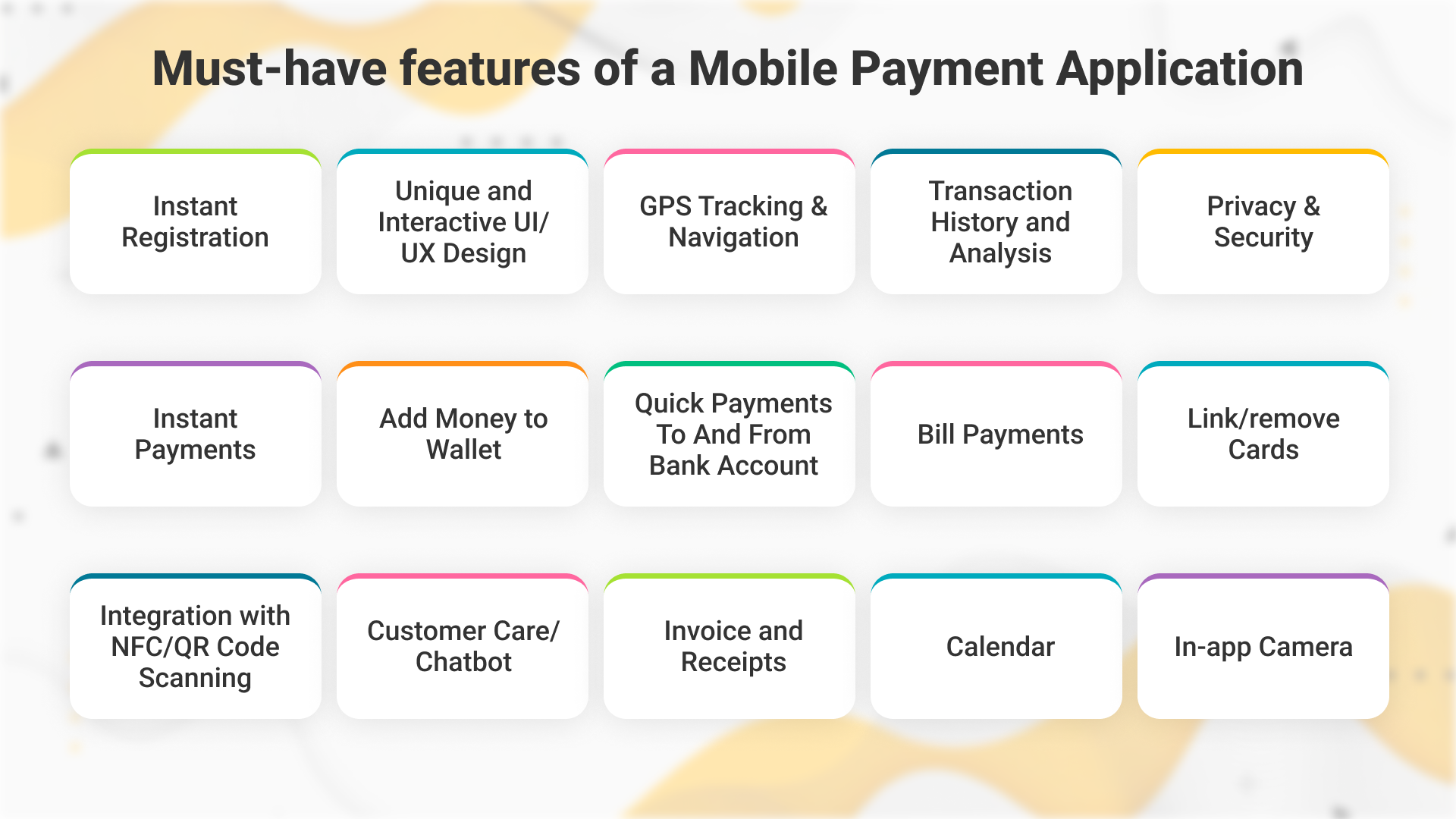
Must-have features of a Mobile Payment Application
Keep certain features in mind if you hope to develop an impactful mobile payment app.
1. Instant Registration
Users must be able to register to the payment app quickly.
The process should include:
- Download
- Install the App
- Add Personal Data
- Follow KYC Process
- Confirm Details with a Code
- Add Pin, Fingerprint Lock, and Password
- Link Cards
- Add Money to the Wallet
2. Unique and Interactive UI/UX Design
UI/UX is the first impression of your application. You have to make sure it is perfect or close to it. A unique and convenient payment app design can capture and maintain the attention of many users.
3. GPS Tracking & Navigation
Users can locate people and make payments with GPS tracking and navigation.
4. Transaction History and Analysis
Users can keep track of their transactions with this feature. And figure how much money they spend in a week or month with the app’s analysis feature.
Such a feature helps users monitor and limit their spending better.
5. Privacy & Security
Your mobile payment app must have password protection, fingerprint lock, OTP verification, QR code scanning, tokenization, biometrics, and security questions. Such technology protects the financial data of users from theft and fraud.
6. Instant Payments
Many payment apps are famous for their instant payment features.
Make sure your app also helps users make payments within seconds. Deal with any bugs/errors that could slow down this process.
7. Add Money to Wallet
Users must be able to add money to their wallets from their bank accounts. A wallet must also have a limit setting where the users can set a limit for their wallet spending.
8. Quick Payments To And From Bank Account
Users must also be able to transfer money to the bank account from their wallet. The transfer from the bank to the wallet must be quick as well.
9. Bill Payments
Users prefer a payment app with a feature to pay bills, rent, loans, utility payments, and credit card payments.
10. Link/remove Cards
Users must be able to link multiple debit and credit cards to the payment app wallet. It will only make things more convenient for the users.
11. Integration with NFC/QR Code Scanning
You will need to integrate your app with technology like NFC and QR code scanning to provide instant and contactless payment options.
12. Customer Care/Chatbot
A customer care/chatbot feature will solve all customer queries/doubts with AI assistants and chat executives.
13. Invoice and Receipts
A user must receive a digital receipt or invoice of every transaction when they send or receive money.
14. Calendar
The calendar feature will keep track of all upcoming bills and due dates. It can also send reminders to users to make the payments on time.
15. In-app Camera
The in-app camera feature is essential to integrate QR code scanning payment technology in your app.
Conclusion
Mobile payment apps are platforms that simplify all transactions for regular users and business establishments. Contactless, easy, and instant payments are the must-have qualities of any payment.
You must understand the importance of every feature in such apps. It will help you develop an app that stands out. It’s best to get professional assistance from an app development company to create influential mobile payment applications.
