

Modern B2B users expect real-time insights inside the applications they already use. Embedded business intelligence (BI) meets this demand by integrating analytics directly into software workflows. This article explains why traditional BI falls short for B2B platforms and how Zoho Analytics enables scalable, secure, and white-label embedded analytics that improve decision-making, engagement, and product value.
Key Takeaways
- Embedded BI has become a core expectation, not a premium add-on, in modern B2B software.
- Traditional BI tools slow decision-making by forcing users to switch platforms or rely on static reports.
- Embedded analytics improves user engagement, retention, and satisfaction by delivering insights at the point of action.
- Zoho Analytics supports secure embedding, role-based access, and white-label customization for SaaS and enterprise products.
- Role-based analytics ensures users see only relevant data while maintaining strict security in multi-tenant environments.
- Embedded BI reduces development time and long-term maintenance costs compared to building analytics from scratch.
- Scalable analytics infrastructure allows B2B platforms to grow without redesigning reporting systems.
There has been a tremendous growth in B2B applications in recent years. Customers do not require any reports that are no longer moving, an outdated dashboard, or monthly spreadsheets delivered to their inbox. Business is currently faster than that. The decision-makers desire to have access to insights the moment they want it – right within the same application they are accustomed to using to run and manage their business.
This change in anticipation is among the factors that have made embedded business intelligence (BI) an inseparable element of the current B2B platforms. Organizations no longer regard analytics as an independent operation; they are integrating knowledge into their software applications. Zoho Analytics is a viable solution for embedded BI, offering efficiency, scalability, and cost-effectiveness.
That is why embedded BI with Zoho Analytics is such a successful fit with B2B applications- and more product teams are utilizing it over interim BI solutions.
Table of Contents
The Truth Behind the Traditional BI in B2B Software
Analytics remains an external element in a myriad of B2B settings. Whenever users need insight, they must either log in to a different BI tool, export data to spreadsheets, or have an analyst create a report. This strategy adds inefficiencies and, in most cases, delays the decision-making process.
The traditional BI defines some of the most common pitfalls, such as:
- Failure to adopt individual BI systems.
- Users are being bombarded with complicated and over technical reporting systems.
- Slow access to meaningful, actionable information.
- Expensive development, licensing, and maintenance fees.
In the case of a B2B application, this model is no longer viable. Analytics cannot be perceived as an additional system that users have to study and operate. Rather, it must also be a part of the product experience, right at the point of decision-making.
Traditional BI vs Embedded BI in B2B Applications
The table below highlights why traditional business intelligence tools are no longer sufficient for modern B2B platforms—and how embedded BI better aligns with today’s product and user expectations.
| Feature / Factor | Traditional BI | Embedded BI |
|---|---|---|
| User Access | Requires logging into a separate BI platform or exporting data | Built directly into the application users already work in |
| Decision Speed | Slower due to context switching and delayed reports | Faster, real-time insights available at the point of decision |
| User Experience | Often complex, technical, and analyst-driven | Intuitive, role-based, and designed for everyday users |
| Adoption Rates | Low to moderate due to learning curve | High, since analytics feels like part of the product |
| Customization | Limited and often expensive to modify | Highly customizable dashboards and views |
| Branding | Third-party branding visible | White-label analytics that match the product UI |
| Data Relevance | Generic reports not tailored to user roles | Role-based insights tailored to each user or organization |
| Maintenance Effort | High development and ongoing maintenance costs | Reduced overhead with managed analytics infrastructure |
| Scalability | Difficult and costly to scale as data grows | Designed to scale with users, data, and complexity |
| Business Impact | Supports reporting after the fact | Actively drives smarter, faster business decisions |
Why This Comparison Matters for B2B Product Teams
For B2B software companies, analytics is no longer just a reporting function—it is part of the product itself. Embedded BI shifts analytics from a passive, back-office role into an active decision-support feature. Platforms that adopt embedded analytics, particularly with solutions like Zoho Analytics, gain a measurable advantage in usability, customer satisfaction, and long-term retention.
The Importance of the Embedded BI to B2B Applications
Embedded BI enables reports, dashboards, and visual insights to be integrated into an application’s interface. Users do not have to switch between tools; they need to learn new platforms. They do not even have to leave the environment where they work, and retrieve the data they require.
In the case of B2B platforms, this will bring about distinct and quantifiable advantages:
- Greater user interaction, since the insights have become more accessible.
- Evidence-based decision-making at higher speeds.
- Added value to the product in general.
- Healthier retention and satisfaction of customers.
Embedded analytics transforms working software into a platform for making decisions. The application does not simply store or process the data, but it actively assists users in understanding what the data means and what to do next.
Why Zoho Analytics Is a Good Fit with Embedded BI
Embedded in a Real-World Application Designed
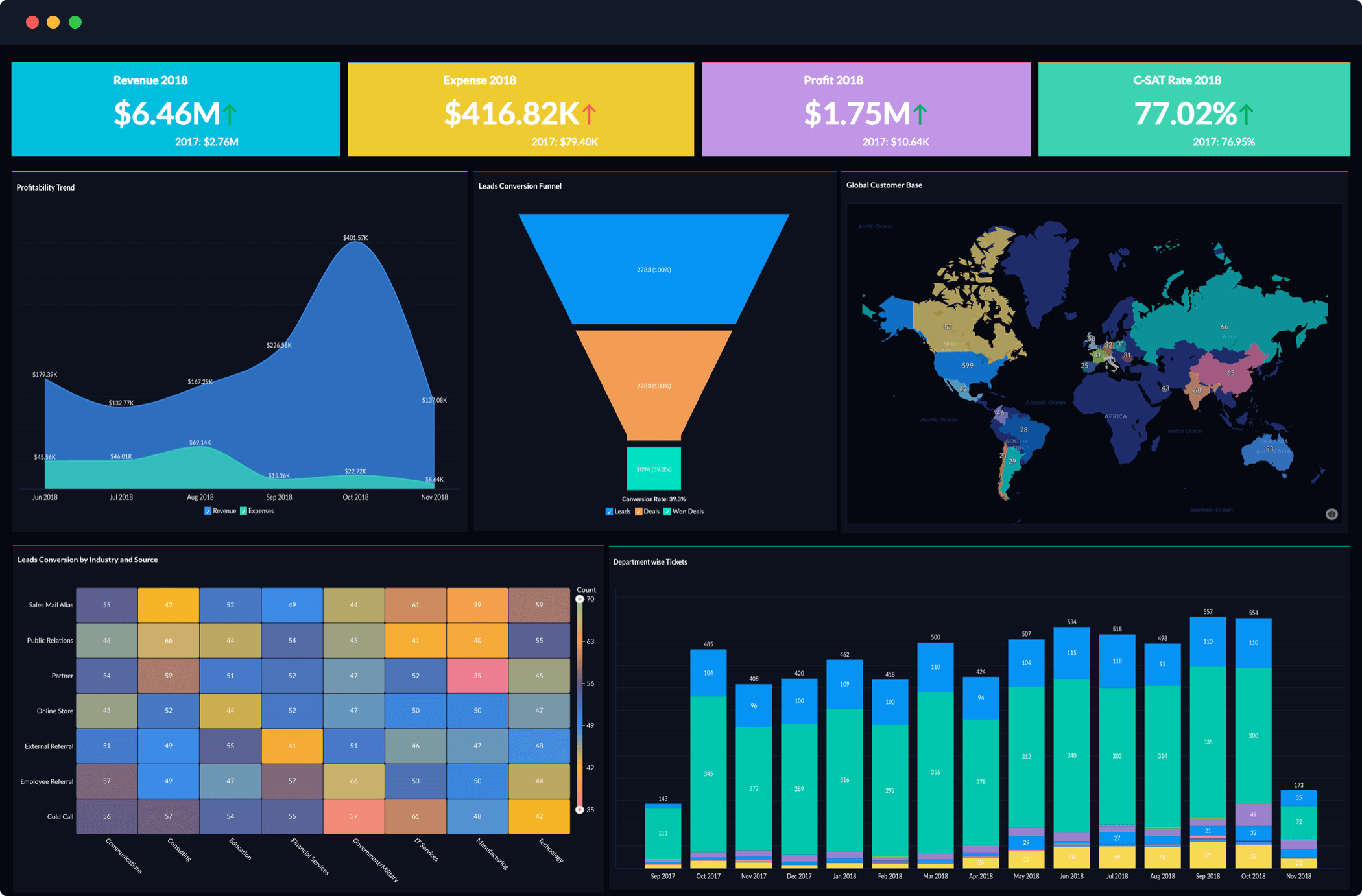
Zoho Analytics is not a simple reporting tool; it is made with pre-built usage cases. It enables dashboards and reports to be safely installed in web portals, SaaS, and internal enterprise software.
Using Zoho Analytics, B2B companies can:
- Install dashboards by secure and reliable means.
- Provide users with permission on a fine-grained basis.
- Role and permission-based customization of views.
- Provide a clean and unbroken in-app analytics experience.
This will enable product teams to deliver analytics more easily, without having to manage complex reporting infrastructure, so they can put more effort into developing essential product features.
White-Label Analytics That Is Like an Extension of the Product
Constancy and branding play important roles in B2B software. The user must be made to feel that analytics is part of the application and not a third-party module.
Zoho Analytics helps in the white-label embedded BI, and enables businesses to:
- Remove external branding
- Match dashboards to the design and UI of the application.
- Provide a common and professional user experience.
- Build trust in their brand.
This can especially be useful to SaaS providers and those enterprises that provide analytics on a product basis to a customer, partner, or affiliate.
Zoho Analytics Applications in B2B
Customer-Facing Analytics
Numerous B2B apps provide customers with access to performance, usage, or ROI data. Embedded BI allows the customers to:
- View real-time dashboards
- Monitor trends and patterns in time.
- Make decisions without being dependent on external reports.
Such transparency increases people’s confidence in the customer and, more importantly, greatly improves the user experience.
Observation of Internal Performance
Internal teams are also as powerful with embedded BI. The sales, operations, and management teams can monitor the following:
- Performance in revenue and pipeline.
- Operational efficiency
- Service-level metrics
- Team productivity
All this data can be found in the same application that they use on a daily basis thereby saving them on context switching and making them more productive.
Roles-Based Intelligence of Various Users
One of Zoho Analytics’ best capabilities is role-based analytics. All information is displayed only to the user based on their role, department, or organization.
This ensures:
- Strong data security
- Less cluttered and more focused dashboards.
- Increased relevance and usability for every user.
These aspects are mandatory in multi-tenant B2B setups where numerous organisations and user functions are simultaneously present on the same platform.
More Rapid Development and Less Maintenance
The process of creating analytics takes a lot of time, expert skills, and maintenance. Zoho Analytics alleviates this pressure through the provision of:
- Visualization elements that are easy to use.
- Scalable and flexible data modeling.
- Minor improvements and modifications.
- Poor infrastructure and overheads.
In the case of a B2B product team, this can be interpreted as increased speed of release, less development, and less long-term maintenance.
Scorable Analytics to Expanding B2B Platforms
With the development of B2B platforms, data volumes increase, and reporting requirements become more complicated. Zoho Analytics is a scalable analytics offering that supports:
- Various and numerous sources of data.
- Growing user bases
- Expanding datasets
- High-level analytics needs.
This enables companies to start with simple analytics and develop features over time without the need to redesign their analytics infrastructure.
Securing and Compliance in Business-to-Business
B2B applications require no compromise on data security. Zoho Analytics is very secure, and it comes with:
- Role-based access and permissions.
- Secure data connections
- Authentication systems for users.
- Compliance prepared data management.
The capabilities help protect sensitive business data at all levels.
Making Business Sense with Embedded BI Using Zoho Analytics
BI is no longer a convenience of B2B applications; it is a competitive advantage. Zoho Analytics provides the scalability, flexibility, and affordability that today’s B2B platforms need.
Analytics allows businesses to:
- Improve user experience
- Enhance customer retention.
- Make decisions more easily and swiftly.
- Create physical value for their product.
Final Thoughts
Embedded BI alters how users connect with the data. They do not have to seek reports or wait to be enlightened, but information reaches them intuitively and naturally.
Zoho Analytics features a powerful embedding, white-label option, and scalable architecture, which makes it a great embedded BI platform to use in B2B applications. It becomes an effective differentiator when it is implemented thoughtfully and improves the product experience as well as the long-term value of the platform.
Ready to embed powerful analytics into your B2B platform? Let Zentix Software help you get started.
Frequently Asked Questions (FAQ)
What is embedded BI, and how is it different from traditional BI?
Embedded BI integrates analytics, dashboards, and reports directly into a business application rather than requiring users to access a separate BI tool. Traditional BI often lives outside the core workflow, forcing users to export data, log into another system, or wait for reports. Embedded BI delivers insights exactly where decisions are made, improving speed, usability, and adoption. For B2B software, this shift transforms analytics from a reporting function into a product feature that actively supports daily decision-making.
Why is embedded BI especially important for B2B applications?
B2B users rely on timely, accurate data to manage operations, revenue, customers, and performance. When analytics is disconnected from the application, insights arrive too late to be actionable. Embedded BI allows users to analyze trends, performance metrics, and outcomes in real time without leaving the platform. This increases engagement, reduces friction, and positions the application as a decision-support system rather than just a data repository.
How does Zoho Analytics support embedded BI for SaaS and B2B platforms?
Zoho Analytics is designed to embed dashboards and reports securely within web portals, SaaS products, and internal applications. It supports role-based access, fine-grained permissions, and customization to ensure users only see relevant data. Its white-label capabilities allow companies to match analytics to their branding and UI, creating a seamless experience. This enables product teams to deliver powerful analytics without building or maintaining complex BI infrastructure internally.
Can embedded BI be secure and compliant in multi-tenant environments?
Yes. A well-designed embedded BI solution includes role-based access control, authentication, and secure data connections. Zoho Analytics supports these requirements, making it suitable for multi-tenant B2B platforms where different organizations and user roles coexist. Properly implemented embedded BI protects sensitive data while still delivering personalized insights, ensuring compliance without sacrificing usability.
Is embedded BI expensive or complex to implement?
Compared to building analytics from scratch, embedded BI platforms significantly reduce development time, cost, and maintenance. Solutions like Zoho Analytics offer scalable data modeling, reusable visualizations, and minimal ongoing overhead. This allows B2B companies to start with essential analytics and expand over time, making embedded BI both cost-effective and future-proof.
Who should consider using embedded BI with Zoho Analytics?
SaaS providers, enterprise software companies, and B2B platforms that want to increase product value, customer retention, and engagement should strongly consider embedded BI. It is especially valuable for companies that provide customer-facing analytics, role-based reporting, or data-driven decision tools as part of their core offering.
