

Building a diverse investment portfolio is one of the most effective ways to grow wealth while minimizing risk. By spreading your investments across asset classes, regions, sectors, and investment vehicles, you create a financial safety net that protects against market volatility. This guide explains how diversification works, why it matters, and how strategies like rebalancing and selective use of alternative assets help strengthen your long-term financial outlook.
Key Takeaways
- Diversification works by spreading your investments across asset classes, sectors, and geographic regions to reduce risk and capture more stable, long-term returns.
- Rebalancing regularly keeps your portfolio disciplined, ensuring it stays aligned with your risk tolerance and financial goals.
- Alternative investments add another layer of diversification, but require careful research due to higher fees, complexity, and risk.
- A combination of the right investment vehicles—ETFs, mutual funds, individual securities, and robo-advisors—helps you build a well-rounded, efficient portfolio.
- Global diversification reduces home-country bias, helping investors capture opportunities in expanding markets and hedge against localized downturns.
Introduction
Developing a robust and diverse investment portfolio is one of the most reliable paths to building wealth and securing personal financial stability. By spreading investments across different asset types and markets, investors can minimize risk while seizing new opportunities for growth. Sound portfolio diversification is not simply about having several investments—it’s a strategic allocation designed to withstand economic shocks and changing market cycles. To learn more about expert portfolio management and how industry professionals approach diversification, explore the insights from Charles Nabit Investment Executive.
Today’s markets are dynamic, with global events impacting local economies like never before. Whether you’re a new investor or looking to optimize your current holdings, understanding the foundations of diversification can put you on the path to more consistent long-term results. A transparent, research-backed approach ensures your investments are protected regardless of market fluctuations.
Table of Contents
Summary Table: Diversification at a Glance
| Diversification Area | What It Means | Why It Matters | Examples / How to Apply |
|---|---|---|---|
| Asset Class Diversification | Spreading investments across different types of assets. | Reduces risk and balances growth with stability. | Stocks, bonds, real estate, commodities, cash equivalents. |
| Geographic Diversification | Investing across multiple countries and regions. | Minimizes exposure to country-specific economic or political risks. | U.S. markets + Europe + Asia + emerging markets (via ETFs or mutual funds). |
| Sector Diversification | Allocating investments across various industries. | Protects against downturns in one sector and captures broader market growth. | Tech, healthcare, consumer goods, energy, finance, industrials. |
| Investment Vehicles | The platforms or structures used to invest your money. | Helps balance convenience, costs, control, and diversification efficiency. | Mutual funds, ETFs, individual stocks/bonds, robo-advisors. |
| Regular Rebalancing | Adjusting your portfolio back to target allocations. | Maintains your intended risk level and long-term strategy. | Schedule-based rebalancing (quarterly/annual) or threshold-based (5–10% drift). |
| Alternative Investments | Non-traditional assets that behave differently from stocks and bonds. | Offers additional diversification and unique return opportunities. | REITs, private equity, hedge funds, commodities, crypto (for experienced investors). |

Understanding Asset Classes
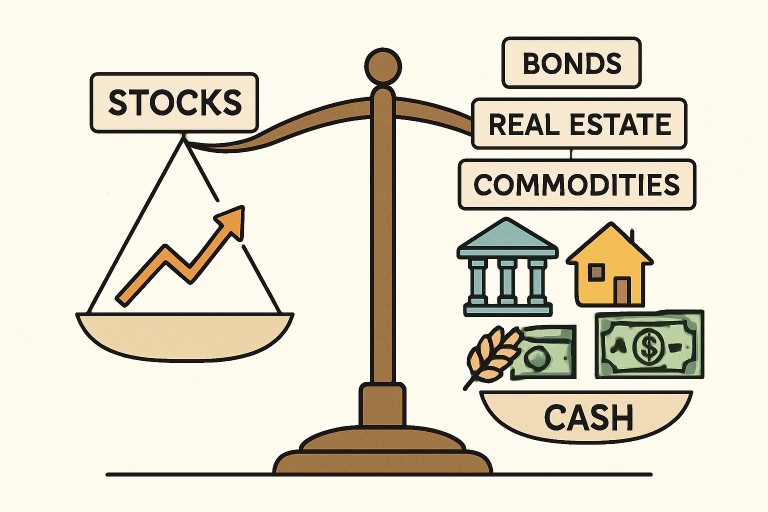
Diversification begins with recognizing the core asset classes available to investors. Each class reacts differently to market forces and economic environments, making them crucial building blocks for any portfolio:
- Equities: Investments in stocks represent ownership in companies, offering capital appreciation and dividend potential. Historically, equities have outpaced other asset classes in long-term returns, but they also carry higher volatility.
- Fixed Income: Bonds and other debt instruments tend to be less volatile and provide steadier income streams, making them suitable for preserving capital and moderating portfolio risk.
- Real Estate: Property investments can provide rental income, capital growth, and a buffer against inflation. Real estate often moves independently from equity markets, making it a strong diversification tool.
- Commodities: Resources like precious metals, oil, and agricultural goods act as effective hedges against inflation and government policy shifts.
- Cash and Cash Equivalents: Money market funds and savings deposits are the most liquid assets, ideal for stability, but typically offer limited growth potential.
A well-allocated portfolio will balance these elements based on your investment goals, time horizon, and risk appetite.
Geographic Diversification
Limiting investments to a single country or region exposes you to localized risks—such as changes in government policy, economic downturns, or currency devaluations. Incorporating international holdings, such as developed and emerging market assets, decreases country-specific exposure and introduces higher growth opportunities from expanding economies. Geographic diversification is integral in reducing systemic risk and capturing global growth. This aligns with guidance that, according to Investopedia, emphasizes the benefits of spreading investments across multiple regions, which helps reduce concentrated vulnerabilities while enhancing access to global opportunities. Geographic diversity also includes considering currency risks, different regulatory frameworks, and market maturity levels.
Sector Diversification
Within each asset class, industries can perform differently based on economic cycles, technological changes, and consumer trends. Sector diversification ensures that your entire portfolio isn’t overly exposed to downturns in one area—such as technology, energy, or financial services. Spreading investments across multiple sectors helps insulate against sector-specific risks and harnesses opportunities as different industries expand at varying rates. For example, when technology stocks face headwinds from regulatory changes, other sectors such as healthcare or consumer goods may remain resilient or even outperform. Sector-focused ETFs or mutual funds make it easier for investors to achieve this form of diversification efficiently.

Investment Vehicles
Choosing how to access each asset class and market is a critical decision in your diversification strategy. Several investment vehicles offer investors flexibility and convenience:
- Mutual Funds and ETFs: These funds pool capital from numerous investors, providing instant diversification within and across asset classes. ETFs, in particular, offer low fees and are easily traded like stocks.
- Individual Securities: Building your own basket of stocks, bonds, or real estate allows greater control but requires substantial research and ongoing management.
- Robo-Advisors: Automated platforms analyze your risk profile and investment objectives to construct and maintain diversified portfolios, rebalancing them as needed to ensure alignment with your goals.
Investment vehicles should be chosen based on your investing experience, account size, and willingness to actively manage your assets.
Regular Rebalancing
As market values of your holdings fluctuate, your exposure to specific asset classes and sectors can drift from your original strategy. Regular rebalancing—selling portions of overperforming assets and buying underperforming ones—brings your portfolio back in line with your preferred allocation. This discipline helps control risk and maintain the intended balance as market conditions shift.
Alternative Investments
To move beyond traditional risk-return profiles, sophisticated investors often consider alternative investments such as private equity, hedge funds, or cryptocurrencies. These assets typically demonstrate low correlation with standard stock or bond markets, enabling further risk reduction and the potential for unique sources of return. However, alternative investments are often more complex, less liquid, and accompanied by higher fees, so they may not be suitable for everyone. It’s crucial to research thoroughly and weigh the benefits against the potential risks before committing a portion of your portfolio to alternatives.
Conclusion
Smart portfolio diversification involves thoughtful allocation across asset classes, geographies, and sectors, while also considering the suitability of alternative investments. Regular rebalancing is essential to keep your risk profile and strategy on track. By implementing these proven diversification methods, investors can better weather market volatilities and increase their potential for long-term financial success.

FAQ Section
Why is diversification so important in an investment portfolio?
Diversification is one of the most effective risk-management tools available to investors. No single asset, sector, or region performs well in all economic environments. When you diversify, you spread your money across investments that behave differently—meaning when one part of your portfolio struggles, another may hold steady or even gain value. This reduces the impact of downturns and helps smooth out your long-term returns. Diversification also prevents overexposure to any single risk factor, such as an industry disruption, political event, or market crash. Over time, well-diversified portfolios tend to deliver more stable performance because losses in one area are offset by gains in another. Ultimately, diversification helps you stay invested, avoid emotional decision-making, and build wealth steadily and sustainably.
How many asset classes should I include in a well-diversified portfolio?
There is no one-size-fits-all number of asset classes, but most diversified portfolios include at least four to six: equities, fixed income, real estate, commodities, cash, and sometimes alternatives. What matters most is not the number of asset classes but how differently they behave in various market conditions. For example, stocks and bonds often move differently, while real estate and commodities can hedge against inflation. Cash adds stability and liquidity, even though it provides minimal returns. Alternative investments can deepen diversification but carry unique risks that require research and caution. The right mix depends on your risk tolerance, investment goals, and time horizon. A younger investor may prioritize equities and international assets, while someone nearing retirement may lean more heavily toward bonds and income-producing investments.
How often should investors rebalance their portfolios?
Most experts recommend rebalancing at least once or twice a year, but the ideal frequency depends on how actively you want to manage your portfolio. Some investors prefer quarterly reviews, while others rebalance only when their allocations drift beyond a certain percentage—such as 5% from the target mix. The goal of rebalancing is simple: maintain your desired risk level. Over time, strong-performing assets grow larger, while lagging ones shrink. Without rebalancing, your portfolio may become riskier than intended. Rebalancing encourages disciplined investing by forcing you to trim winners and buy undervalued assets. It also prevents emotional decision-making, such as chasing performance during market highs. Whether done manually or automated through robo-advisors, consistent rebalancing helps maintain long-term strategy alignment and protects you from unwanted risk creep.
Should everyday investors consider international investments?
Yes—international investments can play a valuable role in a balanced portfolio. Limiting your investments to your home country creates “home-country bias,” which concentrates your risk in one economy, one political system, and one currency. By investing globally across developed and emerging markets, you gain exposure to higher-growth regions, different economic cycles, and more diverse industries. International diversification also helps reduce the impact of domestic downturns, political changes, or regulatory shifts. While foreign markets may introduce risks such as currency fluctuations or economic instability, broad-based international ETFs and mutual funds make global exposure accessible and relatively low-cost. For most investors, including at least some international allocation—often between 20% and 40% of equities—helps improve long-term performance while lowering overall volatility.
Are alternative investments worth adding to a diversified portfolio?
Alternative investments—such as private equity, hedge funds, REITs, venture capital, or cryptocurrencies—can enhance diversification because they often move independently from traditional markets. This means they may perform well even when stocks or bonds decline. However, alternatives come with important trade-offs. They can be less liquid, harder to understand, more volatile, and carry higher fees. Some require long lock-up periods or have lower regulatory oversight. For experienced investors or those working with advisors, alternatives can provide opportunities for higher returns or unique risk hedges. But they should never replace the core of your portfolio. Instead, consider alternatives as a supplement—typically 5–15% of a portfolio—only after your foundational investments across stocks, bonds, and real estate are solid and well-managed.
What’s the first step for someone just beginning to build a diversified portfolio?
The first step is understanding your personal risk tolerance and financial goals. Before choosing investments, you should know why you’re investing, how long you plan to invest, and how much volatility you’re comfortable with. This helps you create a clear target allocation—how much goes into stocks, bonds, real estate, or other assets. Next, start with broad, low-cost index funds or ETFs that offer instant diversification across sectors and geographies. These can form the foundation of your portfolio without requiring deep market knowledge. Set up automatic contributions to build consistency and consider using a robo-advisor if you prefer a hands-off approach. As your knowledge grows, you can expand into additional sectors, global markets, or alternative investments—but always build from a solid, well-structured base.
