

Every major eCommerce platform & marketplace—from Amazon to Shopify—has integrated AI tools to help sellers generate product descriptions at scale, promising improved operational efficiency. Yet beneath this technological adoption lies a growing concern: are AI-generated product descriptions actually helping sellers improve their engagement and conversion rates, or are they silently sabotaging sales?
Many sellers and marketers express concerns about using AI to create eCommerce product descriptions. Discussions on forums such as Reddit highlight issues like generic content and misrepresentation of product features in AI-generated product descriptions, leading to potential misalignments with customer expectations.
So why are AI-generated product descriptions falling short of their potential, and what can brands do to bridge this gap? Let’s understand this in detail here.
Table of Contents
AI-Generated Product Descriptions Are Falling Short Because:
1. Brand Voice is Learned, Not Generated
AI’s ability to churn out product descriptions in seconds is a double-edged sword. While it saves time, it often produces content that feels disconnected from a brand’s unique voice. AI replicates tone — it doesn’t create or preserve nuanced brand identity across categories or customer personas.
For example, a luxury skincare brand needs aspirational, science-backed language (“clinically proven rejuvenation”) while their children’s sunscreen line requires playful, safety-focused messaging (“Protects delicate skin, so the fun never stops under the sun”). AI struggles with these contextual voice adjustments, often defaulting to generic product descriptions without a cohesive brand storytelling across SKUs.
2. Critical Product Insights Often Get Lost in AI Descriptions
While generating product descriptions, AI tools often focus on obvious product attributes, missing the specific details that actually drive purchase decisions. These tools struggle to identify which product specifications matter for users according to their specific scenarios. This creates a critical gap between what AI thinks customers need to know and what they actually need to buy.
For example, when creating a product description for a laptop bag, AI mentions “padded compartments” but fails to specify the exact laptop sizes that fit, whether it accommodates chargers and cables, or if the zippers are weather-resistant—details that determine purchase confidence.
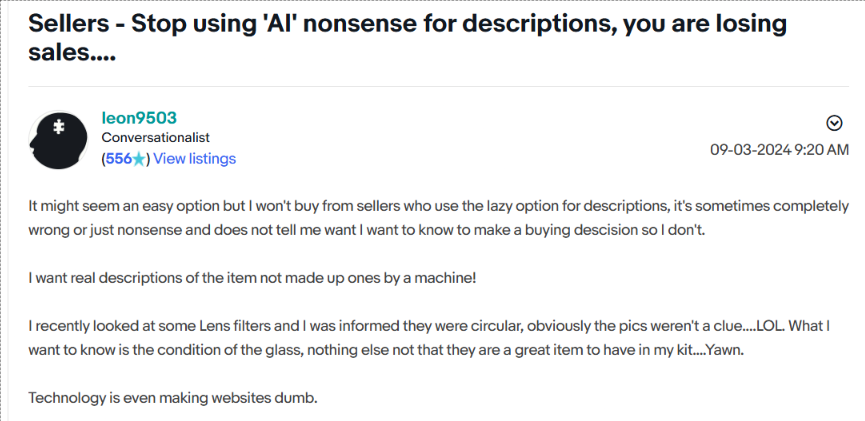
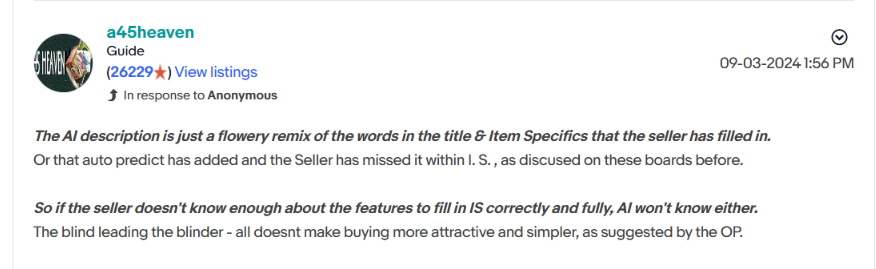
Frustrated with such AI-generated product descriptions, some eBay shoppers have shared their experience on the forum, explaining how sellers are losing potential sales with the blind use of AI:
3. SEO Isn’t Just About Keywords — It’s About Relevance + Behavior
AI treats SEO like a checklist—stuff in the target keywords, hit the character count, and call it optimized. But modern search algorithms have evolved far beyond keyword matching. Now, search intent mapping and relevance matter more than anything. To optimize your product description for relevant search queries, you need to first understand the buyer’s journey and search intent—whether a user is looking for informational content or is ready to make a transactional purchase.
For example, when someone searches “best running shoes,” AI assumes they want to buy immediately and generates descriptions packed with purchase-focused language. It overlooks the fact that many searchers are in research mode or comparing options. AI can’t distinguish between “I’m ready to buy” and “I’m still learning” search behaviors. And that is the reason that AI-based content generation tools suggest simple call-to-action like “Shop now”, instead of “Explore our outdoor gear”, which aligns with user intent to learn more before purchasing.
AI optimizes for search crawlers, not human readers. It creates awkward keyword-stuffed sentences that technically rank but fail to engage users meaningfully. This approach backfires, as search engines now prioritize user engagement metrics, such as time on page and bounce rates, over keyword density.
4. Same Generic Ad Copies Kill Sales in Crowded Niches
AI pulls information from common training data, risking a generic, me-too copy. AI training data represents the collective “average” of existing product descriptions across the internet. When thousands of sellers tap into this same data pool, they inevitably produce nearly identical copy.
Search for “wireless bluetooth headphones” on any marketplace, and you’ll find hundreds of AI-generated descriptions using identical phrases: “crystal clear sound,” “all-day comfort,” and “seamless connectivity.” When every description is the same, it leads to a race to the bottom where price becomes the only differentiator. What’s missing is the unique selling proposition — the story behind the product, what makes it premium or unique, or how the product fits into the lifestyle of a specific customer.
Search algorithms and customers both crave unique content. Generic AI descriptions reduce search visibility and fail to capture the specific benefits that make products stand out in oversaturated markets.
5. User-Generated Feedback and Dynamic Iteration Are Hard for AI Alone
AI models are trained on historical data; they inherently lack access to the latest user-generated feedback and real-time shifts in consumer preferences. This means AI-driven eCommerce content generation tools can’t dynamically adjust product descriptions to reflect current trends or emerging customer sentiments that influence buying decisions.
For example, if reviews consistently highlight that a “compact vacuum” is unexpectedly quiet, a human would quickly revise the copy to include “ultra-quiet performance”—a high-converting benefit AI wouldn’t surface unless re-trained with that feedback loop.
Human oversight or input is required for such iterative adaptability that keeps descriptions relevant and conversion-focused — a critical edge that AI offers in autopilot mode.
6. Cross-Sell Hooks Can’t Be Strategically Integrated in AI-Generated Product Copy
According to McKinsey, effective cross-selling can boost eCommerce revenue by 20–30%, mainly because buyers often make impulse decisions when presented with contextual add-ons. But this kind of persuasive subtlety is exactly where AI falls short.
AI-generated product descriptions typically focus on one item. They lack awareness of catalog relationships, shopper intent, or merchandising strategy. Even when prompted, AI tools struggle to naturally weave in complementary products without sounding forced or robotic.
To integrate cross-sell or upsell cues effectively, the writer must understand:
- Customer buying patterns
- Which products are frequently purchased together
- How to present related items without disrupting flow or sounding salesy
Here is a great example of strategic copywriting where cross-selling is promoted in an engaging and informative manner in a product description:

Such product copywriting boosts average order value without feeling like a hard sell. AI can’t replicate that nuance unless it’s spoon-fed every layer of catalog logic and behavioral data.
Hybrid Intelligence: The Winning Model Is Human-in-the-Loop
In eCommerce product description writing, AI fails not because it’s robotic—it fails because it optimizes for patterns, not persuasion. The role of humans in AI-driven content is invaluable. Without human refinement, AI content leaves revenue on the table. Instead of debating AI-generated content versus human-generated content, the focus now needs to shift to how to utilize both AI and human expertise together to achieve the best of both worlds.
Here is the proven three-stage framework to follow for generating high-quality product descriptions at scale while reducing the turnaround time by 40-60%:
- First Draft Creation by AI – Let AI generate the first draft by integrating keywords, compiling basic features, and ensuring that essential product specifications and SEO elements are covered. Use tools like Jasper, Copy.AI, ChatGPT, Claude, etc., with refined prompts to get technically accurate eCommerce product descriptions for thousands of SKUs.
- Content Enhancement by Human Writers: Subject matter experts can then review AI-generated product descriptions to transform them into engaging, persuasive copy. They can add emotional triggers, highlight unique selling points, and mention related products in a contextual flow for cross-selling opportunities. They can refine the language to ensure that product descriptions align with the brand voice and don’t sound like a generic copy.
- Final Checks by Editorial Team: The refined descriptions can be proofread by the editorial team to ensure that all information is grammatically and factually correct, and that relevant keywords are optimized in a natural manner for enhanced search visibility and engagement rates.
Key Takeaways:
To effectively follow this hybrid framework for eCommerce product description writing, brands can:
- Invest in AI tools and an in-house team of human writers. This approach gives full control over the content creation process but requires significant investment in both tools and talent.
- Outsource product description writing to a provider that already follows this human-in-the-loop methodology. This option enables brands to leverage subject matter expertise and AI-driven efficiency without the need for significant upfront investment in tools or hiring.
The choice between these two options depends on the brand’s scalability needs, budget, and preference for control.
Conclusion: AI Is the Engine. Humans Are the Drivers
In eCommerce, content is king—but only when it speaks to the customers in their intended tone, addressing their pain points and needs. While AI tools and GPTs accelerate the product description writing process for large SKUs, it is human expertise and oversight that ensure relevance, persuasion, and emotional engagement. Product descriptions are more than just text: they are strategic revenue drivers and your competitive edge lies in how effectively you generate them by combining technological efficiency with human persuasion.
