This article was originally published on October 25, 2024, and updated on April 11, 2026.
Shopify Capital can be a fast way for eligible merchants to access working capital, but speed alone does not make it the best financing choice. Before accepting an offer, merchants need to understand how repayment works, how fees affect the true cost of funding, and whether the money will actually generate a return.
Key Takeaways
- Shopify Capital is an embedded financing option for eligible Shopify merchants, not a traditional open-application bank loan. Shopify says eligibility is evaluated automatically and can change over time.
- In the United States, Shopify Capital loans are repaid from a daily percentage of sales, not a fixed monthly installment, and current loan structures can include either a fixed fee or a monthly fee.
- Shopify says U.S. loans must be fully repaid within 18 months maximum and include minimum-payment thresholds at 6 and 12 months.
- Some Shopify Capital loans are secured and may involve a UCC-1 financing statement, which means merchants should read the agreement carefully instead of treating the funding like a casual dashboard feature.
- Shopify Capital can be useful for inventory, marketing, and growth opportunities, but it is a better fit for merchants with healthy margins, clear forecasting, and a defined use for the funds than for businesses trying to patch ongoing cash flow problems. This conclusion is an editorial assessment based on Shopify’s current repayment structure and small-business financing conditions.

For ecommerce merchants, access to working capital often determines whether a business can move quickly enough to capitalize on demand. The challenge is that traditional financing is not always built for the realities of online retail. Inventory needs change fast, advertising costs can spike without warning, and a seasonal surge can turn into a missed opportunity if cash is tied up elsewhere.
That is why products like Shopify Capital attract attention. They promise speed, convenience, and a funding experience that feels more closely aligned with how an online store actually operates. For the right merchant, that can be valuable. But convenience should never be confused with cheap capital or risk-free capital.
A smarter way to evaluate Shopify Capital is to ask three questions. First, how does it really work today? Second, what does it cost compared with other options? Third, will the money be used in a way that generates more margin and cash flow than the financing costs take away?
According to Shopify’s help documentation, Shopify Capital is a financing program that offers eligible businesses loans and merchant cash advances, depending on market and offer availability. Shopify says eligibility is evaluated automatically using factors that include store history, platform use, customer interactions, disputes, and compliance with Shopify policies. For U.S. merchants specifically, Shopify’s current loan documentation says repayment is taken as a daily percentage of sales, with either a fixed-fee or monthly-fee structure, and that loans must be paid off within a maximum of 18 months. Shopify also notes that some loans may involve collateral and a UCC-1 financing statement.
That combination of speed and platform integration is exactly why Shopify Capital deserves a more careful look. It may be a good fit for some merchants, but it is not automatically the right answer simply because an offer appears in the dashboard.
Table of Contents

What Is Shopify Capital?
Shopify Capital is Shopify’s financing program for eligible merchants. Rather than using a traditional public loan application process, Shopify evaluates merchants automatically and makes offers available through the Shopify admin to stores that meet its criteria. Shopify says eligibility is continually reviewed and can change over time, which means a merchant may not always see an offer, and seeing an offer does not guarantee funding forever.
In practical terms, Shopify Capital is designed to help merchants access working capital more quickly than they might through a bank or more traditional small-business lender. That can matter when businesses need funds for inventory, marketing, expansion, hiring, or other growth-related purposes. Shopify’s documentation says its financing can support uses such as inventory, marketing, retail locations, and staffing.
What makes Shopify Capital especially appealing is that it is embedded inside the Shopify ecosystem. Merchants do not have to start from scratch with a lengthy underwriting process just to see whether financing may be available. That platform-level convenience is one of its biggest strengths. At the same time, merchants still need to treat the offer as a real financing obligation and not simply as an easy dashboard feature.
How Shopify Capital Works
This is where many articles stay too general, and that is a mistake. Merchants do not just need a broad explanation. They need to understand how the structure actually affects their cash flow and planning.
According to Shopify’s U.S. help documentation, Shopify Capital loans are provided as a lump sum, and repayment is made from a daily percentage of sales until the total payment amount is repaid. Shopify also says merchants can choose between a fixed-fee repayment plan and a monthly-fee repayment plan, depending on available offers. Under the fixed-fee structure, the cost is known upfront and does not change based on how quickly the balance is repaid. Under the monthly-fee structure, the amount charged each month stays fixed, but the total borrowing cost depends on how long the loan remains active.
That distinction matters because it changes the economics of the funding. A fixed-fee structure offers predictability because the total cost is known from the beginning. A monthly-fee structure may cost less if the loan is repaid quickly, but it can become more expensive if repayment stretches out over time. Either way, the merchant must think carefully about how the repayment drain interacts with margins, reinvestment needs, and working capital.
Shopify also says that current U.S. loans must be repaid within a maximum term of 18 months. The company further states that merchants are required to meet minimum-payment thresholds at the 6-month and 12-month marks, with 30% of the total loan due by month 6 and 60% of the total payment amount due by month 12. If those minimums are not met, Shopify says the merchant may have to make a manual payment and could risk default under the agreement.
That is one of the most important details in the entire discussion. Shopify Capital may seem flexible because repayment is tied to sales, but it is not open-ended. Merchants still need enough commercial momentum to stay on pace.
Who Is Eligible for Shopify Capital?
Eligibility is another area where many thin articles oversimplify. It is not accurate to reduce Shopify Capital to a pure sales-volume decision.
Shopify says eligibility is automatically evaluated using factors that can include sales, disputes, customer interactions, how long the merchant has been using the Shopify platform, and compliance with Shopify’s Terms of Service. Shopify also says eligibility is continually evaluated and subject to change.
That means merchants should think of Shopify Capital as an offer-based financing channel rather than a funding source that is simply “available if your revenue is high enough.” Store quality, account health, operational consistency, and platform history all appear to matter. For business owners, that is useful context because it means strong store operations and lower friction with customers may indirectly support financing eligibility.
It also means merchants should avoid building plans around funding that has not yet been offered. Shopify Capital can be helpful when it appears, but it is still Shopify’s decision whether and when a merchant receives an offer.pital as a product anyone can simply apply for on demand. It is better understood as an offer-driven financing channel that becomes available to some stores based on Shopify’s internal assessment.
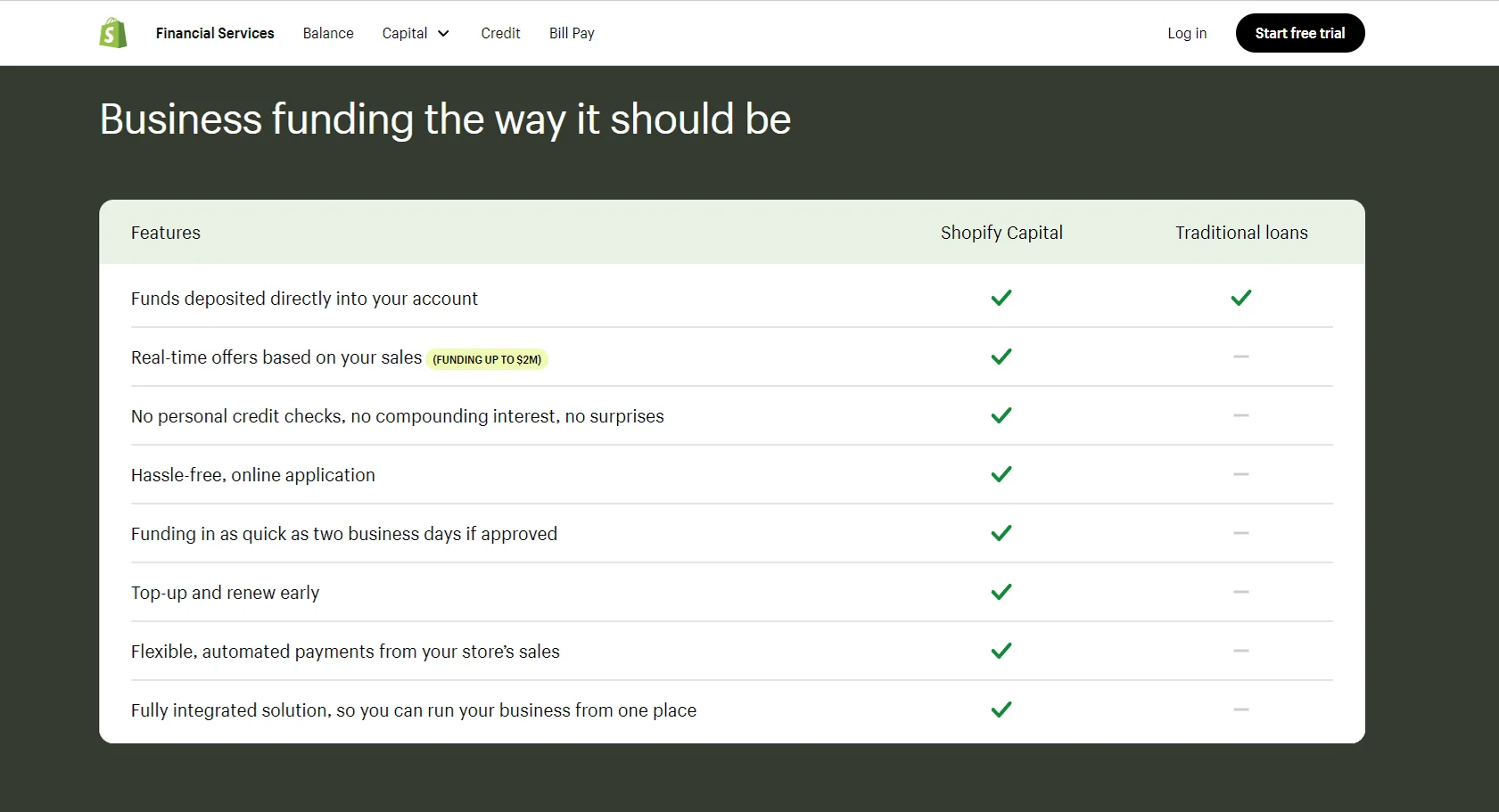
What Shopify Capital Costs
One of the reasons Shopify Capital appeals to merchants is that it can seem easier to understand than a traditional interest-bearing loan. But easy-to-read does not always mean inexpensive, and cost needs to be analyzed from a business standpoint, not just a convenience standpoint.
Shopify’s current U.S. documentation says a merchant repays the loan amount plus a borrowing cost, and the structure may be either fixed-fee or monthly-fee depending on the offer. Under a fixed-fee plan, the fee remains the same regardless of how long repayment takes. Under a monthly-fee plan, the monthly charge stays fixed, but the total cost increases the longer the balance remains unpaid.
For merchants, the practical takeaway is simple: the real question is not just “What is the fee?” but “What is this capital costing me relative to what it helps me earn?” If you use the funds for a proven inventory reorder with healthy margins and predictable sell-through, the cost may be acceptable. If you use the funds for speculative ad spend or to plug recurring operating holes, the financing can become an expensive way to delay a deeper problem.
This is where stronger editorial guidance helps the article stand apart. Merchants do not need another generic explanation. They need help judging financial fit.
What Merchants Often Miss About Repayment
A major weakness in many articles on Shopify Capital is that they describe repayment as flexible without explaining the business implications of that flexibility. That leaves readers with the wrong impression.
Yes, Shopify Capital’s U.S. repayment structure is tied to a daily percentage of sales, which means merchants are not locked into the same kind of static installment payment pattern many traditional loans use. Shopify also says no payment is taken on days when there are no sales associated with the Shopify account or services under the account.
But flexibility does not eliminate risk. In fact, it can create a false sense of comfort. If sales are strong, repayment will move faster, which sounds positive, but it also means more cash is being diverted out of the business during active selling periods. If sales slow down too much, the merchant can still run into the 18-month maximum repayment window and minimum threshold requirements. That is why repayment planning matters just as much as eligibility.
A merchant should never accept Shopify Capital without modeling what daily sales-based repayment will do to inventory cycles, ad budgets, payroll, and cushion cash.
>> READ: Shopify Capital vs. Amazon Lending: Which is the Better Financing Option for Your Business?
When Shopify Capital Makes Sense
Shopify Capital can be a smart financing tool, but usually only when the business already has enough operational discipline to put the money to productive use. Capital tends to work best when it supports something measurable, time-sensitive, and margin-aware.
For example, Shopify Capital can make sense when a merchant needs to reorder a proven best-seller ahead of a high-demand period, fund a marketing campaign with historically strong return on ad spend, improve site performance in a way that is likely to increase conversion rate, or smooth out a short inventory cycle that has clear payoff. Shopify itself notes common uses such as inventory, marketing, retail locations, and staffing.
What those cases have in common is not just growth ambition. It is the existence of a credible path to return. The merchant can point to why the money is needed, what it is expected to produce, and how repayment will fit into the business without starving other priorities.
That is the difference between using capital strategically and using it impulsively.
When Shopify Capital Is a Bad Fit
This is one of the most important sections to include because it gives the article practical value that many weaker pages skip.
Shopify Capital is often a poor fit for merchants with unstable margins, inconsistent cash flow, weak forecasting, or a habit of using financing to cover structural problems. If the business does not clearly understand customer acquisition cost, contribution margin, return on marketing spend, and inventory sell-through, then it is difficult to judge whether taking the offer is helping or hurting.
It can also be a bad fit when a merchant is already feeling squeezed by day-to-day cash needs. Even though repayment is tied to sales, the obligation still pulls money out of the business as revenue comes in. That can create pressure in ways that a merchant does not fully appreciate until they need to reorder products, fund ads, or cover payroll at the same time.
Another issue merchants should not ignore is that Shopify says the loan agreement includes a security interest in business assets as collateral and that a UCC-1 financing statement may be filed depending on the circumstances. That makes the financing more serious than many merchants realize at first glance.

Shopify Capital vs. Other Working Capital Options
A major reason to expand this article is to make it more decision-oriented. Merchants do not just want a definition. They want to know how Shopify Capital compares with alternatives.
The U.S. Small Business Administration says SBA-guaranteed loans can be used for a variety of business purposes, including operating capital, and can range from small amounts to multimillion-dollar financing depending on program and lender. The tradeoff is that SBA-backed funding generally involves more paperwork, more underwriting, and a slower process than something embedded directly in a commerce platform.
That comparison is useful because it helps merchants see Shopify Capital for what it is: not the universal best funding option, but a specific kind of convenience-driven funding that may make sense when speed and platform integration matter more than long-form underwriting.
Table: Shopify Capital vs. Other Common Funding Options
Understanding Shopify Capital becomes much easier when you compare it side by side with other ways to fund a business. This table is helpful because it shifts the conversation from “Can I get this money quickly?” to the more important question: “Which funding option best fits my business model, timing, and cash flow?” Not every business needs the fastest option, and not every business will benefit from the same repayment structure. Seeing the alternatives in one place helps readers evaluate Shopify Capital more strategically.
| Funding Option | Best For | Main Advantage | Main Tradeoff |
|---|---|---|---|
| Shopify Capital | Eligible Shopify merchants who need quick access to funds | Fast, embedded, platform-native financing | Can be more expensive than lower-cost financing alternatives |
| SBA-backed loan | Businesses that can qualify and wait through underwriting | Can support operating capital and other business needs at larger scales | Slower process, more documentation, lender review |
| Business line of credit | Ongoing working capital flexibility | Reusable access to funds as needed | Qualification may be stricter and rates vary |
| Revenue-based financing | Businesses with strong revenue but limited traditional options | Repayment can align with business performance | Often expensive relative to bank-style funding |
| Business credit card or charge card | Very short-term spending needs paid off quickly | Easy access and flexible use | Can become costly if balances are carried |

A Better Way to Decide Whether to Accept an Offer
One of the best ways to strengthen this article for both readers and search engines is to add a practical evaluation framework. Generic pages describe. Better pages help readers make a decision.
Before accepting Shopify Capital, a merchant should be able to answer the following questions with confidence. What exactly will the money be used for? What return should that use generate? How long should it take to produce that return? What happens to cash flow if sales are weaker than expected? And does the business have enough margin to absorb repayment without disrupting inventory, operations, or marketing?
If the merchant cannot answer those questions, then the funding may be premature.
Table: Shopify Capital Self-Assessment Before Accepting an Offer
Before accepting any financing offer, a business owner should step back and pressure-test the decision. This table works well here because it turns general advice into a practical evaluation tool. Instead of relying on instinct or convenience, merchants can use these questions to assess whether the funding supports profitable growth, fits their margins, and makes sense for their current cash flow position. That added decision-making value also helps the article feel more useful and original.
| Question | Why It Matters | Strong Answer Looks Like |
|---|---|---|
| Do I know exactly what I will use the funds for? | Borrowing without a defined purpose usually lowers ROI | The funding is tied to inventory, marketing, or a specific operational investment |
| Can I estimate the return from that use? | Financing should produce more value than it costs | You can estimate payback using margin, conversion, or sell-through data |
| Are my margins strong enough to handle repayment? | Daily sales-based repayment still reduces usable cash | The business can absorb repayment without disrupting operations |
| Am I using this for growth rather than survival? | Capital works better when supporting healthy momentum | The funds are helping expand, not just cover recurring shortfalls |
| Have I compared this offer to at least one alternative? | Speed should not stop you from checking fit | You understand how this compares with SBA, LOC, or other funding sources |
| Do I understand the agreement details? | Secured financing deserves careful review | You reviewed fees, repayment rules, minimums, and any collateral terms |
Why Embedded Financing Appeals to Small Businesses
It is also worth stepping back and looking at the broader environment. Shopify Capital is not gaining traction in a vacuum. Small businesses often face genuine financing friction, especially when they need fast or flexible working capital.
The Federal Reserve’s Small Business Credit Survey is a national source of data on small-business financing conditions and experiences. Its 2026 Report on Employer Firms says revenue and employment growth held steady year over year in the 2025 survey, but firms were slightly more likely to report revenue decreases than increases, and expectations for future growth declined.
That backdrop helps explain why embedded funding products keep attracting attention. When businesses feel pressure, speed and accessibility become part of the value proposition. But again, accessibility does not automatically mean the funding is the best fit. It just means the friction to access it is lower.
That distinction is important, and articles that explain it clearly are more useful than pages that simply repeat product features.
Final Verdict: Is Shopify Capital Worth It?
Shopify Capital can be worth it for the right merchant, but only when the business uses it with discipline. Its real advantages are speed, convenience, and integration within the Shopify ecosystem. For merchants with clear margins, healthy operations, and a specific profitable use for the funds, that can be powerful.
But Shopify Capital is not automatically a “good” offer just because it appears in the dashboard. Merchants still need to understand the repayment structure, review the fee model carefully, plan for minimum-payment requirements, and consider whether the capital is truly driving profitable growth. Shopify’s current U.S. documentation makes clear that these loans involve real repayment obligations, defined thresholds, and in some cases secured-loan treatment.
The most financially disciplined merchants do not ask only whether they qualify. They ask whether the money will create more value than it costs and whether their business can carry the repayment without weakening the very operations they are trying to grow.
Frequently Asked Questions (FAQs)
Is Shopify Capital a loan or a cash advance?
Shopify Capital can include different funding types depending on the market and offer. Shopify’s eligibility documentation says Shopify Capital offers are provided to eligible merchants, and its U.S. loan documentation specifically explains how loans work for merchants in the United States. That is why merchants should not assume every Shopify Capital offer functions the same way in every region. The most reliable approach is to review the actual offer details inside the Shopify admin and compare those terms against your planned use of funds, expected return, and ability to handle repayment without putting pressure on normal business operations
Does Shopify Capital check personal credit?
Shopify’s eligibility page emphasizes merchant and business-related factors such as sales, disputes, customer interactions, time on the Shopify platform, and compliance with Shopify’s Terms of Service. That is different from the traditional application path many banks use. However, merchants should not interpret a simpler eligibility model as a reason to be casual. Even if the process feels faster and more platform-driven, Shopify Capital is still a real financing obligation with repayment rules and business consequences if the agreement is not managed carefully.
How fast does Shopify Capital fund?
For U.S. merchants, Shopify says funding applications are usually reviewed within one to three business days, though some cases may take longer. If approved, the loan amount is then deposited into the business bank account, and the daily sales-based repayment process begins shortly after disbursement. That speed is one of Shopify Capital’s strongest selling points, but merchants should weigh it against total cost, repayment pressure, and expected return on the funded activity.
Is Shopify Capital cheaper than an SBA loan?
Not necessarily. Shopify Capital may be easier and faster to access for eligible merchants, but that does not automatically make it the cheaper option. SBA-backed loans are often used for working capital and can be attractive for businesses that qualify and can tolerate a more traditional underwriting process. The tradeoff is that SBA financing is typically slower and more documentation-heavy. Shopify Capital may win on speed and convenience, while SBA options may be stronger on cost or structure depending on the borrower and lender.
How is Shopify Capital repaid in the United States?
According to Shopify’s U.S. loan documentation, repayment is made using a daily percentage of sales. Shopify also says new U.S. loans must be fully repaid within a maximum term of 18 months and include minimum-payment thresholds at the 6-month and 12-month marks. That means merchants should not just think of repayment as “automatic.” They need to actively monitor progress, understand how sales pace affects repayment, and be prepared to make manual payments if needed to stay compliant with the agreement.