
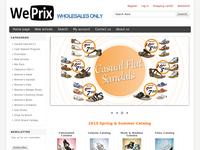
 WePrix.com (FEATURED WHOLESALER)
- WePrix.com
- Fax: 626-217-9255
- Email: support @ weprix.com
- WePrix.com is a women shoes wholesaler and distributor located in California USA, We DO NOT require Seller Permit and MOQ. We carry all kinds of fashionable women shoes such as Heels, Pumps, Sandals, Flats, Sneaker, Boots etc. The Rhinestone dressy evening shoes are our best sellers. Our main market is North/South America and European Counties. Brands – Celeste | Fahrenheit | Mark and Maddux | NINA, Clearance items are up to 40% off.
Ceri Wholesale
- Ceri Wholesale
- 18541 Gale Ave., City of Industry, CA 91748
- 626-810-3231
- Online wholesaler of accessories, handbags, hats, shoes, lingerie, belts, jewelry, sunglasses, hats, and apparels
ItalianModa.com
- ItalianModa.com
- ItalianModa.com Srl, via Carlo Moreschi 60, 22072 – Cermenate (Como), Italy
- Phone: +39-031-722473 / +39-348-3064482
- Fax: +39-0314036965
- Online Wholesale Italian Clothing, Shoes, Handbags, Fashion Accessories, Jewelry, Home Textiles
TOP Footwear, USA
- TOP Footwear, USA
- 1230 Santa Anita Ave #G South El Monte, CA 91733 U.S.A
- 1-(626) 279-1717
- We provide wholesale prices for shoes, such as Women’s comfort wedge shoes, Men’s dress & Causal shoes, Boots, Sandals and Slippers etc. We always offer the lowest price as we can.
TooTooMart China Wholesale
- TooTooMart China Wholesale
- 20/F, Building NO.1, Capital A Partners, NO.20, Gongti East Road,
- Chaoyang District, Beijing, PRC 100020
- + 86 9510 5561 Fax: + 86 65892222
- Tootoomart is a B2B online trading platform that leading in China. There are over hundreds of thousands of global buyers purchase products that made in China through Tootoomart for competitive prices with good quality
MyLeather.com
- MyLeather.com
- 955 Venice Blvd Los Angeles, CA 90015
- 213-741-1391
- Myleather.com is one of the largest direct Manufacturers and Importers of leather products in the world. We are also the exclusive wholesale distributor of Xelement Boots and Jackets. Our line sells so well that our major retail online and mall partners dominate the online and offline leather world.
MARJIM Shoe Company
- MARJIM Shoe Company
- Herald Towers 50 W. 34th St. Suite 16A7 New York, NY 10001
- Wholesale Brazilian and Italian Ladies Shoes.
Rakel Shoes
- Rakel Shoes
- 743 E Pico Blvd Los Angeles, CA 90021
- U.S. Phone: 213-742-0434
- If you are in the shoe business whether you are a shoe shop holder or market trader you really need to buy wholesale shoes. And there is no better place to go than Rakel’s shoes.
ShoeNet.com
- ShoeNet.com
- 266 West 37th Street, Suite 803, New York, NY 10018 USA
- Sales: (406) 476-5000
- U.S. Phone: (212) 796-0535
- Buy 4 Less Electronics Inc. is a Wholesale Distributor, Liquidator, and Exporter of Name-Brand Consumer Electronics, Photo, and Computer products.
Star Bay Group
- tar Bay Group
- 390-400 Railroad Ave. Hackensack, NJ 07601
- Phone (201) 678-1688
- Toll Free 1-888-882-5588
- Star Bay Group, Inc. is a professional footwear importer & exporter specializing in various slippers, including beaded, sequin, Moccasin, EVA, indoor and casual, sports sandals, and so on. A wholesaler focusing on U.S. and South America market, we have over 500 items in our showroom/warehouse in Hackensack, NJ. We have our own manufacturing facility in China, and are partnered with several shoe manufacturing facilities..
247 Fashion Store
- 247 Fashion Store
- 760 S. Stimson Ave. Industry, CA 91745
- TEL: + 1 (909) 839 – 0186
- We carry a wide range of top brands of women fashion shoes. You will love our wide variety of women shoes, designer women shoes at wholesale discount prices. You will love our wide variety of women shoes, designer women shoes at wholesale discount prices.
Aerosoft Footwear
- Aerosoft Footwear
- 1-800-318-0129
- Made in Thailand, now sold in the USA. Aerosoft is one of the most leading foot wear manufacturer and retailer of Shoes & sandals.
SPECIAL NOTE: PowerHomebiz.com has not fully verified the reliability of these wholesalers. PowerHomeBiz.com is also not affiliated with any company listed here. Please conduct due diligence to check these wholesale companies and contact them directly to establish your business relationship. The listing is for reference only and does not necessarily mean as an endorsement by PowerHomebiz.com, LLC.
If you are a wholesaler, and wish to be included in our list, We offer a special listing/featured wholesaler for a minimal “one time” donation of $100 per category, to cover manpower expenses. The corresponding link to your website will be activated . Please Use our Wholesale Directory Listing Payment Form to get your business included in our directory.